
Editor’s Note: Authored by the Oper Hand Insights Desk under the direction of Steve Ross. Every insight is verified against Steve’s 30-year ‘Oper Hand Lens’, acquired in the trenches of B2B startups and scaleups. Content is cross-referenced with sources such as The Wall Street Journal, Forbes, Harvard Business Review, Entrepreneur, and others.
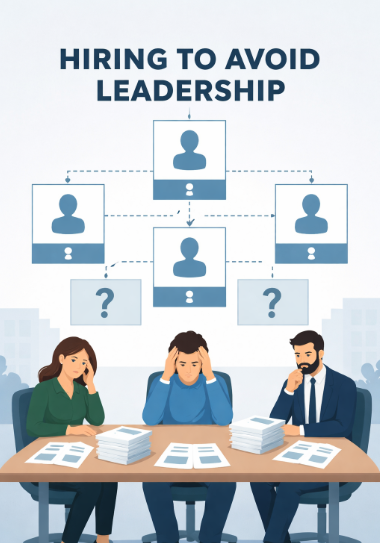
When leadership avoids deciding what actually needs to get done, hiring fills the void. Roles get created before the work is clearly defined. People are added to absorb ambiguity instead of own outcomes. Scaling breaks when hiring replaces leadership instead of starting with clarity on the real jobs and decisions first.
TL;DR
- If hiring feels urgent, leadership clarity is usually late.
- New roles do not create ownership. Decision rights do.
- Scaling CEOs name constraints first, then hire to multiply leadership.
- Investors read your hiring plan as a proxy for decisions and discipline.
Nothing is technically broken.
But nothing moves unless you touch it.
Work is happening everywhere except where decisions are supposed to land. Threads circle. People wait. Progress feels oddly dependent on your availability.
Managers ask for people. Recruiters send resumes that look impressive enough to quiet the noise. Hiring feels like progress because it seems decisive. It feels responsible. It feels like leadership.
At the scaling stage, that feeling lies.
When a company crosses into absolute scale, every hire magnifies what already exists. Clear systems move faster. Vague systems slow down. Ownership either spreads or collapses upward. Hiring to solve the right problem determines the direction that magnification goes.
You know the signal. The org chart grows, but speed drops. Titles increase, but accountability stays fuzzy. You add managers, yet decisions still land on your desk.
That is not a talent problem.
That is a leadership problem.
Why this matters now
Scaling companies face a specific temptation. Revenue works. Demand exists. The market rewards speed. The board expects momentum.
In that moment, hiring becomes the fastest way to appear in control. You can show action without naming tradeoffs. You can add capacity without fixing decision flow. You can postpone uncomfortable calls by hoping people absorb the chaos.
That is why hiring to solve the right problem at scale. Early stages forgive it. Scale punishes it.
The penalty compounds quietly. Each hire added to an unclear system increases coordination cost. Each manager added without decision rights increases latency. Each layer added without ownership trains the company to wait.
The pattern you need to name
Here is the plain truth. You hire when you have not decided.
You hire because priorities stay vague. You hire because roles overlap. You hire because conflict feels expensive. You hire because letting someone go feels risky. You hire because headcount feels safer than clarity.
Hiring to solve the right problem fails when headcount substitutes for decision-making. The company grows people to avoid growing up.
The pattern is consistent. A constraint appears. Leadership avoids naming it. A role is created to absorb the pain. The constraint remains. The organization gets heavier.
This does not happen because you lack intelligence. It happens because you feel exposed. Every scaling CEO does.
What hiring cannot fix
Hiring does not resolve decision rights. Only explicit ownership does.
Hiring does not settle priorities. Only tradeoffs do.
Hiring does not create accountability. Only consequences do.
Hiring does not align teams. Only operating cadence does.
This is where most scaling companies violate a simple operating principle.
Hiring skips that rule.
Instead of fixing unclear decisions, vague ownership, or unresolved tradeoffs at the leadership level, companies push the problem downstream and hope new people absorb it. They do not. They inherit it.
People cannot own outcomes they do not understand. They escalate instead of deciding. They protect scope instead of owning results.
You then interpret this as a talent miss and hire again.
That loop erodes trust. It trains avoidance. It teaches capable leaders to wait.
The cost curve you are ignoring
Most CEOs model salary and benefits. Very few model friction.
Every avoidant hire adds hidden cost. Decisions slow because ownership stays unclear. Managers hedge because authority stays vague. Strong operators disengage because standards feel optional.
The most dangerous cost is key-person risk. When everything still routes through you, valuation compresses. Buyers and boards see dependency and discount future performance.
Hiring to solve the right problem reduces that risk. Hiring to mask indecision increases it.
What strong operators do instead
Strong scaling CEOs reverse the sequence. They name the constraint before adding people. They decide before they delegate. They clarify authority before they hire.
Before approving headcount, they answer four questions. What decision is stuck. Who owns it. What outcome defines success. What authority that owner needs.
Only after those answers exist do they hire. At that point, hiring multiplies leadership instead of masking fear.
This feels slower in the moment. It is faster in reality.
Leadership force multiplication at scale
At scale, leadership is not control. It is distribution.
Leadership force multipliers build owners, not helpers. They push decisions down. They clarify authority. They create an execution bench investors trust.
When aligned correctly, teams decide without waiting. Managers lead instead of manage. The CEO stops being the bottleneck.
This is how capacity expands without chaos.
The judgment you cannot avoid
Before your next hire, pause.
Ask whether you are adding leadership or avoiding a decision. Ask whether you have named the constraint or buried it. Ask whether this role owns an outcome or absorbs confusion.
If the answer feels uncomfortable, that is the work.
Headquartered in Bellevue, WA, with an office in Boulder, CO, Oper Hand installs the revenue and operations systems that generate revenue, not burn it.
Hiring to solve the right problem ends when you choose clarity over comfort.
The verdict
The hire is not the decision.
The decision is the decision.
Your year will not be defined by how many people you add.
It will be defined by whether you solved the right problem first.