Sales Execution

Blue faceted diamond with a pronounced crack running through it, symbolizing sales execution breakdown when deals are not actively driven to decisions and momentum stalls.

This failure mode explains how companies break when deals are not actively driven to a decision, causing momentum to fade and leadership heroics to replace systems.

Sales execution breaks when deals aren’t actively driven to a decision.

Early on, leadership fills the gap. Founders and sales leaders close deals themselves. They jump in late. They pull strings. They save the quarter. The company learns that escalation works.

As volume increases, leadership heroics become the execution model. Deals move only when someone senior intervenes. Reps wait. Managers hover. The system never forms because the system is still a person.

Execution problems usually surface once live deals expose weak qualification and funnel rigor upstream. Leads & Pipeline

So deals stall.

Follow-up slips. Momentum fades. Opportunities sit in the pipeline without pressure or progress. Reps stay busy, but nothing changes in the buyer’s world. Late-stage deals rot quietly until leadership steps in again.

Revenue hides the cost. For a while.

As teams grow, execution fragments. Reps work on islands. Each one runs their own version of how deals move. Product, pricing, leadership, proof points, and urgency are applied inconsistently or too late. What exists on paper isn’t enforced in practice.

If a system exists at all, it’s usually too complicated to run, ignored by reps, loosely managed by sales leaders, and barely inspected by executives. It looks organized. It isn’t real.

When deals don’t close, learning stops. No one truly knows why deals were won or lost. There’s no shared language for progress. The same mistakes repeat. Late-stage failures feel mysterious instead of predictable.

Failure turns political.

Sales blames marketing and sales development. Marketing blames sales. Leaders referee instead of fixing the execution engine. Time burns. Money burns. Trust erodes.

What Actually Breaks

Sales execution doesn’t fail because people aren’t trying. It fails because no one owns driving deals to a decision using a shared system.

Leadership heroics mask the gap.
Activity disguises the stall.
Process without enforcement becomes theater.

What This Looks Like At Scale

Execution is not persuasion. It is disciplined progress.

It means:

  • One clear owner per deal.
  • Explicit next steps with consequence.
  • Coordinated use of company resources at the right moment.
  • Inspection of progress, not storytelling.
  • Willingness to advance or kill deals decisively.

This is how momentum replaces hope.

Why This Section Exists

Sales execution breaks when deals move forward by heroic efforts instead of systems.

This section exists because revenue stalls at scale when ownership is unclear, follow-up is inconsistent, and leadership has to step in to keep deals alive.

It explains:

  • Why leadership heroics block scalable execution.
  • How deals stall without active decision pressure.
  • Why follow-up fails when ownership is unclear.
  • How fragmented execution destroys momentum.
  • What it takes to install and enforce a simple, shared system that drives deals to a decision.

The goal is not more activity. The goal is a sales system that closes without rescue.

Oper Hand intervenes at this failure mode by redesigning how deal-driving decisions, ownership, and execution are structured.

Recommended Reading Order

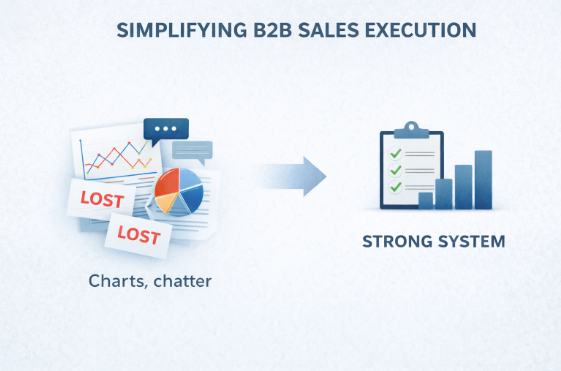
Illustration showing messy charts, chatter, and “lost” sales activity transitioning to a checklist and upward bar chart labeled “strong system,” representing simplifying B2B sales execution through clear processes and structured sales systems.
January 19, 2026

Your Sales Problem Is Self-Inflicted

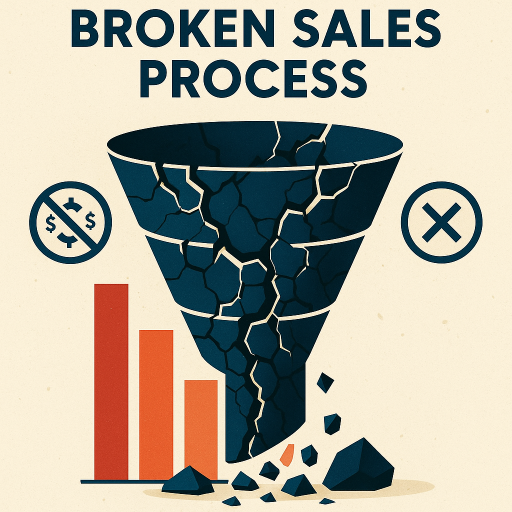
A fractured sales funnel with cracks, broken pieces falling onto declining bar graphs, symbolizing the consequences of a broken sales process. The design emphasizes the need for optimization, with a key focus on 'Fixing a Broken Sales Process
June 10, 2025

Fixing a Broken Sales Process

A mechanic performing an engine overhaul, using tools to fix the car's internal components, representing the concept of a sales overhaul strategy for growth
February 20, 2025

Recognize These 6 Patterns? Sales Overhaul Strategies for Growth

Scroll to Top
Call Us