
Editor’s Note: Authored by the Oper Hand Insights Desk under the direction of Steve Ross. Every insight is verified against Steve’s 30-year ‘Oper Hand Lens’, acquired in the trenches of B2B startups and scaleups. Content is cross-referenced with sources such as The Wall Street Journal, Forbes, Harvard Business Review, Entrepreneur, and others.
This piece is about process discipline for growing companies and the quiet line where it stops creating leverage and starts lying to you. At the growing stage, process discipline for growing companies determines whether execution accelerates or slowly freezes under the weight of its own rules.
TL;DR
- Process creates leverage when it removes friction from known work.
- Process lies when it replaces ownership, judgment, or speed.
- Growing companies misuse process to feel safe instead of decisive.
- Strong operators treat process as infrastructure, not protection.
- If process slows decisions, it is already costing you.
- Your calendar looks controlled.
- Meetings have agendas.
- Docs live in shared folders.
- Workflows are mapped.
- Everyone knows the steps.
And yet decisions feel heavier. Execution slips. You are still the final stop for issues that should not reach you.
That tension is not accidental. It is an indicator.
At the growth stage, process discipline becomes necessary for growing companies. It also becomes dangerous if you do not know where it helps and where it lies.
Why This Matters Now
You are no longer surviving. You have customers. You have revenue. Volume is increasing.
Founder heroics cannot scale here. Process enters because it must.
But this is the moment where many companies confuse order with progress. They install the structure before clarifying ownership. They document before deciding. They add steps before removing waste.
The cost of getting this wrong is measurable. McKinsey research cited by Crebos in 2025 found that 20–30 percent of operational expenditure is lost each year to rework, miscommunication, repetitive tasks, fragmented systems, friction, and misaligned processes. That loss does not come from lack of effort. It comes from systems that exist without discipline or ownership.
The result looks organized. It feels responsible. It quietly slows the business.
This is why process discipline for growing companies is not about adding more process. It is about knowing exactly what process is allowed to do and what it must never replace.
Where Process Actually Helps
Process works when the work is known.
It stabilizes repeatable actions. It creates predictable handoffs. It reduces mental load for leaders. It exposes performance gaps instead of hiding them in anecdotes.
A good process does three things.
- First, it removes friction from tasks that should not require judgment. Invoicing, onboarding, reporting, and handoffs. If the work is the same each time, structure earns its place.
- Second, it makes ownership visible. A step without an owner is not a process. It is a delay disguised as structure.
- Third, it increases speed and reliability If a process adds clarity but slows execution, it failed.
This is the productive side of process discipline for growing companies. It frees attention for decisions that actually matter.
Where Process Starts to Lie
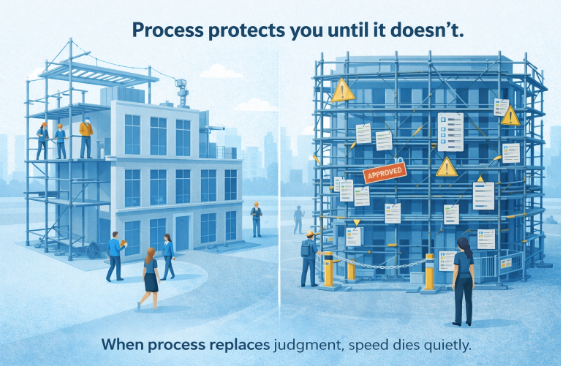
Process lies when it becomes a substitute for judgment.
You see it when decisions are routed through workflows rather than people. You see it when meetings exist to validate compliance instead of making calls. You see it when escalation becomes the default because no one is clearly accountable.
Process also lies when it exists to avoid discomfort.
Instead of confronting underperformance, teams add review steps. Instead of deciding, they document. Instead of trusting a leader, they create approval chains.
This is not discipline. This is avoidance with a professional face.
When process discipline for growing companies turns into permission-seeking, speed dies quietly.
The Core Operator Distinction
Strong operators make a clear distinction.
Process removes constraints.
Process does not grant permission.
Discipline creates clarity.
Comfort creates delay.
Control comes from ownership, not checklists.
If a process requires consensus to move forward, it is lying. If a process exists without a clear decision owner, it is lying. If a process slows an obvious call, it is lying.
The lie feels safe. That is why it spreads.
The Growing Business Failure Pattern
This pattern shows up predictably.
You add process before decision rights.
You document instead of resolve.
You hold meetings instead of making decisions.
You escalate because no one owns the outcome.
The founder remains the pressure valve. Everything still routes to you. The system looks mature but behaves fragile.
This is where process discipline for growing companies breaks down. The company adds structure without redistributing authority.
The Test: Is Process Helping or Hiding
Ask yourself three questions and answer them honestly.
- What decisions still require you that should not.
- What process exists without a named owner who can decide.
- Where speed has decreased even though clarity increased.
If you cannot answer these quickly, process is already hiding the problem.
What Strong Operators Do Differently
They sequence correctly.
Ownership comes first.
Structure comes second.
They design workflows to move decisions down, not slow them. They kill mechanisms that protect feelings instead of outcomes. They remove steps that exist only to look responsible.
Throughput matters more than symmetry. Execution matters more than consensus.
Efficiency Optimizer Alignment
This is where the Efficiency Optimizer work matters.
Removing operational drag is not about refinement. It is about subtraction. Clarifying roles. Tightening handoffs. Eliminating decision latency.
Headquartered in Bellevue, WA, with an office in Boulder, CO, we install the revenue and operations systems that generate revenue, not burn it. If you’re ready to optimize your sales process and drive real growth, let’s talk.
The Verdict
Process is a tool. It is not protection.
If it feels safe, it is already failing you.
If it slows decisions, it is costing you.
If it replaces judgment, it is lying.
Growing companies win by deciding faster, not documenting more.