
TL;DR
- Most B2B pipeline is not as healthy as it looks. Deals do not go cold. They stall because no one is driving them to a decision.
- The rep is not always the problem. The system is. Activity gets rewarded. Movement does not get measured. Stalled deals are the structural output.
- The cost compounds invisibly. Stalled deals age while forecasts are built around revenue that will never close.
- Surface explanations, budget, timing, a champion who “ghosted”, almost never match the real reason a deal stopped moving. The gap between what the rep believes and what the buyer experienced is where the problem lives.
- Stalled deals are a system design problem. They fix when the system changes, not when the team works harder.
Every CEO who has run a pipeline review has felt it. The pipeline looks good. The reps appear busy. And then you start asking questions. When did this deal last move? What is the next step? Who owns the decision on their side? The answers are vague or missing, and the deal that looked like a Q3 close has been in the same stage for six weeks.
That is not a closing problem. It is a stalled deals problem, and it is more common than most sales organizations want to admit.
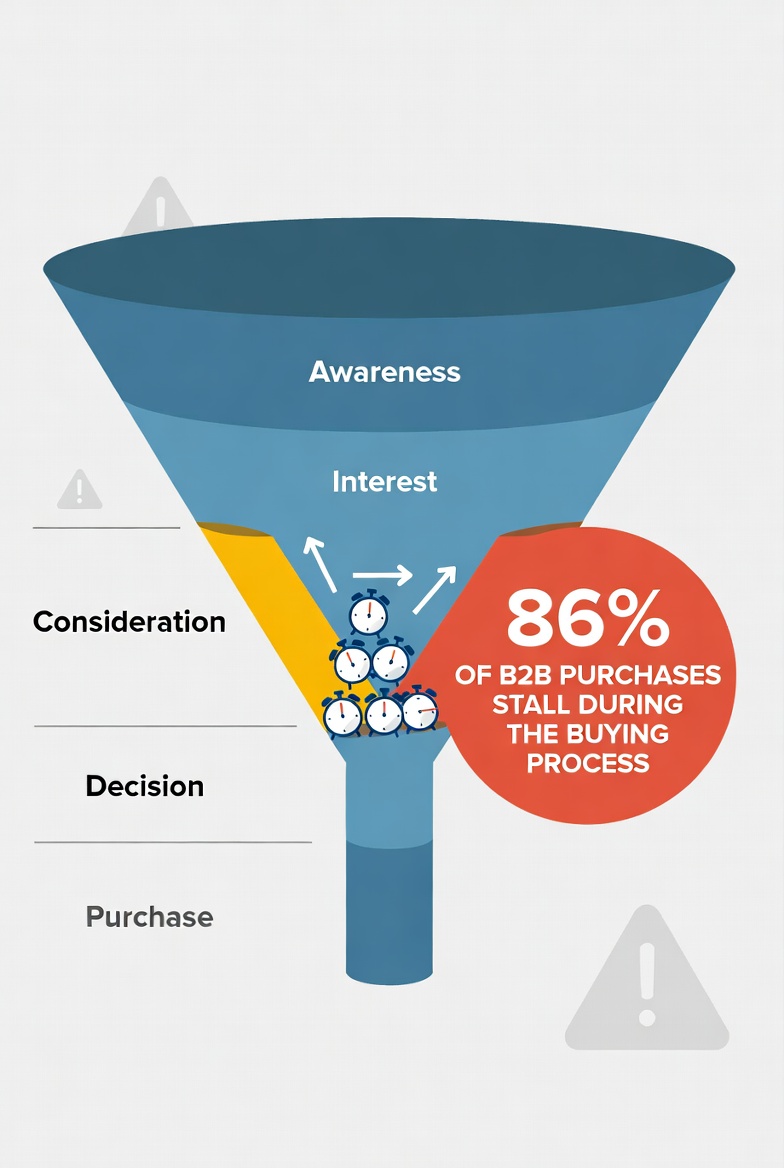
Research from Forrester found that 86 percent of B2B purchases stall during the buying process. That number is not a buyer behavior statistic. It is an indictment of how most B2B sales systems are built. Deals do not stall because buyers are indecisive or budgets are tight. They stall because the selling org has no mechanism for driving them forward, and the selling org doesn’t really understand things from the buyer’s side.
The cost is invisible until it is not. Stalled deals do not fail loudly. They age quietly in the CRM while the team reports progress and leadership forecasts revenue that never closes. By the time the quarter ends and the pipeline gets scrubbed, the damage is already months old.
Why Stalled Deals Are a System Problem, Not a People Problem
The instinct when deals stall is to look at the rep. They did not follow up aggressively enough. They did not create urgency. They let the buyer go dark. That framing is wrong often enough to be dangerous.
Stalled deals are not always performance problem in most scaling companies. They are a design problem. The sales system was never built to create decision pressure. It was built to track activity. And when a system measures activity, it produces what it measures, calls logged, emails sent, meetings held, while the actual question of whether the deal is moving toward a decision goes unexamined.
The rep is not failing. The rep is doing exactly what the system rewards. The problem is that the system rewards the wrong thing.
Fixing stalled deals requires identifying which part of the system is broken. That starts with understanding the three structural causes that produce them consistently across B2B sales organizations regardless of team size, product, or market.
The Three Structural Causes
- The first is unclear ownership at the deal level. In a scaling sales org, deals often exist in a shared space where the rep manages the relationship, the manager holds the forecast, and the CEO gets pulled in to save the late stages. No single person is accountable for driving the deal to a decision. When the deal stalls, everyone assumes someone else is handling it. No one is. Clear ownership means one person is explicitly responsible for the deal moving forward at every point in the cycle. Not managing the relationship. Not updating the CRM. Moving the deal. That distinction matters because it changes what gets inspected and what gets done.
- The second cause is next steps without consequence. Most B2B sales teams define next steps as calendar entries. The next call is scheduled. The follow-up is sent. The proposal is delivered. None of these are next steps. They are activities. A real next step has a specific outcome, a defined owner on the buyer’s side, and a consequence for inaction. Without those three elements, the next step is just a reason to keep the deal alive in the pipeline without making progress.
- The third cause is the absence of decision pressure. B2B buyers do not create urgency on their own. Competing priorities, internal processes, and the natural inertia of any organization will always push a decision later unless the selling org applies deliberate pressure. That pressure is not manipulation. It is the consistent, structured act of connecting the delay to a cost the buyer has already acknowledged and asking for a commitment that keeps the process moving. Without a mechanism for applying that pressure at the right moments in the cycle, stalled deals are the inevitable outcome.
What a Stalled Pipeline Costs
The most expensive part of stalled deals is not the lost revenue when a deal finally dies. It is the compounding cost of carrying the deal through weeks of false progress before that happens.
Every week a stalled deal sits in the pipeline, a rep’s time is allocated to it. Forecasts are built around it. Leadership attention is consumed by it. And the opportunity cost of the deals that could have been in that rep’s focus instead is invisible because the stalled deal still shows as active.
In a team of ten reps, if any rep carries two or three stalled deals at any point in the cycle, the team’s effective capacity is materially lower than the headcount suggests. The team is busy. Revenue is still short. The gap between those two realities is where the cost of stalled deals lives, and it compounds every quarter the system stays unchanged.
CEOs often respond to this by adding reps. More pipeline volume, in theory, offsets the loss from stalled deals. In practice, it produces more stalled deals at a higher cost because the system that creates them was never addressed. The execution problem scales with the team.
What Drives Deals Instead of Stalling Them
The antidote to stalled deals is not more follow-up. It is a sales system designed around decision progress rather than activity volume.
That system has three components that correspond directly to the three structural causes above.
- The first is explicit deal ownership with accountability attached. Every deal in the pipeline has one named owner who is responsible for its movement, not its management. That owner is inspected on progress, not activity. Did the deal move? If not, why not, and what is the plan?
- The second is next steps defined as buyer commitments. The deal advances when the buyer takes an action, not when the rep sends an email. Every sales interaction ends with a specific commitment from the buyer side, a decision, a conversation, an internal action, with a defined timeline and a consequence for missing it. When a deal cannot produce a buyer commitment, that is diagnostic information, not a reason to schedule another call.
- The third is a structured pressure mechanism applied at defined points in the cycle. Not improvised urgency. A deliberate, repeatable process for connecting delay to cost at the moments in the buying process where decisions are most likely to stall. Entrepreneurs who have built this into their sales system do not have more talented reps. They have a system that does the work that talent alone cannot sustain at scale.
The Inspection Problem
There is a reason stalled deals persist even in companies that know they have the problem. It is that most pipeline inspections are designed to surface activity rather than movement.
The questions in a typical pipeline review are: What is the status? When did you last talk? What is the next step? These questions produce answers that describe the past without assessing whether the deal is actually progressing. A rep can answer all three confidently and have a deal that has not moved in a month.
The questions that surface stalled deals are different.
- What did the buyer commit to last time, and did they do it?
- What decision needs to happen next, and who owns it on their side?
- What happens to the buyer’s business if this does not close this quarter?
These questions are harder to answer and harder to fake. They also make stalled deals visible before they become scrubbed pipelines.
The gap between the first set of questions and the second is the gap between a pipeline review that produces comfort and one that produces movement.
There is a deeper inspection problem that internal reviews cannot solve. When a deal goes quiet, the rep fills the silence with a plausible explanation. Budget timing. A competing priority. An unresponsive champion. These explanations are rarely wrong enough to challenge and rarely accurate enough to learn from. The real reason the deal stalled often has nothing to do with budget and everything to do with something the selling org did — or failed to do — that the buyer never said out loud.
Consider what one B2B software company discovered when it finally went back and talked directly to buyers who had not closed. Leadership had been operating on a familiar internal narrative: pricing pressure, budget constraints, longer buying cycles, timing. These explanations were already shaping decisions around pricing strategy and ROI methodology. When structured conversations were conducted with those buyers independently, not sales-led follow-ups, but neutral third-party conversations designed to surface how value was actually evaluated, the findings were materially different. Price was not the blocker. Justification was. Buyers understood the value but could not build a CFO-credible case from what they had been given. The rep thought the deal died on budget. The buyer could not get internal approval because the ROI framing did not hold up under scrutiny. Within two quarters of acting on what buyers actually said, the company recovered $900K in pipeline that had been marked closed-lost. The full story is worth reading if stalled deals are a pattern in your org.
That distinction is what makes buyer-side intelligence a structural asset rather than a post-mortem exercise. When you know why deals actually stall, you can redesign the system at the point where they break, not where the rep assumed they broke.
Where to Start
Stalled deals do not fix themselves with more effort or more reps. They fix when the system that produces them is redesigned. That means defining ownership at the deal level, building next steps around buyer commitments, creating a structured pressure mechanism, and inspecting movement rather than activity.
Stalled deals are not a closing problem. They are a system problem. And system problems have system solutions.