
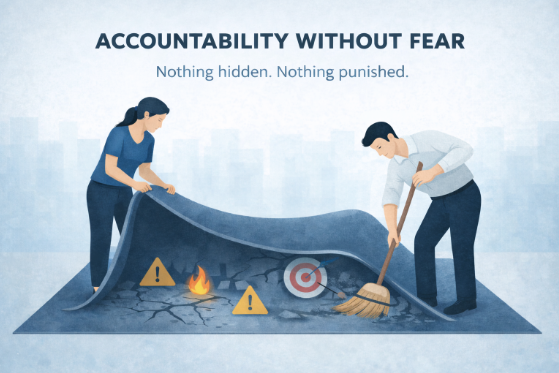
Editor’s Note: Authored by the Oper Hand Insights Desk under the direction of Steve Ross. Every insight is verified against Steve’s 30-year ‘Oper Hand Lens’, acquired in the trenches of B2B startups and scaleups. Content is cross-referenced with sources such as The Wall Street Journal, Forbes, Harvard Business Review, Entrepreneur, and others.
At scale, accountability stops being a cultural value and becomes a system design problem. Accountability without fear is how strong operators regain control without slowing execution or losing people.
TL;DR
- When people hide information, accountability has already failed.
- Defensive behavior is not a people problem. It is a system signal.
- Pressure without clarity creates fear, not performance.
- Accountability without fear is how truth surfaces early and travels fast at scale.
Your dashboards look fine.
Delivery looks stable.
Meetings are full of updates.
And yet, you sense it. Information arrives late. Risks show up after decisions. People manage narratives instead of outcomes.
That is not resistance. That is protection.
At the scaling stage, accountability breaks quietly. Not through conflict. Through silence. When accountability without fear is missing, people do not push back. They disappear behind activity.
Why This Matters Now
As complexity increases, the cost of delayed truth multiplies. One missed handoff turns into a quarter of rework. One softened update turns into a customer issue you cannot unwind.
This is not theoretical. McKinsey & Company found that organizations emphasizing common purpose—defined as clarity of direction combined with meaningful involvement—are 4.1 times more likely to be organizationally healthy than those that do not. That health does not come from motivation. It comes from systems that allow people to surface reality without fear.
This is where accountability without fear becomes a control mechanism rather than a leadership style. It determines whether reality shows up early or only after damage is done.
Founders who miss this assume they need stronger standards. Louder expectations. More follow-up.
They are wrong.
The Signal Most CEOs Misread
When accountability fails, it rarely looks like pushback. It looks like compliance.
People say yes and then hedge.
They report activity instead of outcomes.
They wait for permission before naming problems.
That behavior is not about motivation. It is about risk.
In the absence of accountability without fear, capable leaders calculate exposure before they speak. If accountability feels personal, unclear, or inconsistent, silence becomes the rational move.
Why Accountability Turns Defensive in Scaling Companies
Three conditions create defense.
First, role ambiguity. When ownership overlaps, accountability becomes blame-adjacent.
Second, decision fog. When decision rights are unclear, updates turn political.
Third, consequence mismatch. When consequences feel arbitrary, effort shifts from solving problems to avoiding scrutiny.
In that environment, accountability without fear cannot survive. Pressure replaces structure. Fear replaces ownership.
Pressure Without Structure Is Just Noise
Many CEOs confuse expectations with agreements.
An expectation is what you hope happens.
An agreement is what someone owns, with authority to act.
Repeating expectations harder does not improve outcomes. It trains people to minimize exposure.
At scale, accountability without fear must be structural. It must live in roles, decision rights, and review cadence. Without that, accountability feels like judgment.
Judgment delays truth.
The Control Shift Strong Operators Make
Strong operators stop asking, “Why did this happen?”
They start asking, “Where was ownership unclear?”
They redesign accountability so it does not depend on tone, mood, or presence.
This is where accountability without fear proves its value. It removes fear before enforcing standards. It allows leaders to demand performance without triggering defense.
The shift is quiet. The impact is immediate.
The Ownership Spine Framework
Strong scaling companies converge on the same model.
Every critical outcome has:
- One owner with decision authority.
- Clear input boundaries from others.
- A fixed review rhythm focused on learning, not justification.
This framework creates accountability without fear by design. People surface issues earlier because the system protects truth. Accountability becomes predictable instead of personal.
Predictability is what makes accountability without fear scale.
What Changes When Accountability Stops Triggering Defense
Three things happen fast.
Problems surface sooner.
Meetings shorten and sharpen.
Leaders stop acting as buffers.
Ownership becomes visible and durable. Execution speed increases without adding pressure. This is the operating benefit of non-defensive accountability.
Why This Is a Leadership Force Multiplier
At scale, you cannot be the accountability engine. You must build one.
Leadership Force Multipliers work because they embed accountability without fear into how decisions move and standards hold. Leaders enforce outcomes without creating fear.
That reduces key-person risk. It increases investor confidence. It raises valuation.
Headquartered in Bellevue, WA, with an office in Boulder, CO, we install the revenue and operations systems that generate revenue, not burn it. If you’re ready to optimize your sales process and drive real growth, let’s talk.
Final Reflection
Look at where information arrives late.
That is where accountability feels unsafe.
Fix the system, not the people.
That is how accountability without fear actually works at scale.