Editor’s Note: Authored by the Oper Hand Insights Desk under the direction of Steve Ross. Every insight is verified against Steve’s 30-year ‘Oper Hand Lens’, acquired in the trenches of B2B startups and scaleups. Content is cross-referenced with sources such as The Wall Street Journal, Forbes, Harvard Business Review, Entrepreneur, and others.
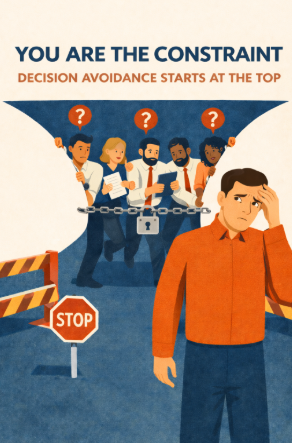
CEO decision avoidance will define your year more than market conditions, capital, or talent.
TL;DR
- The single constraint in your company is not strategy, hiring, or process.
- It is the decisions you delay and the clarity you withhold.
- Teams do not stall from a lack of effort. They stall due to a lack of direction.
- What you avoid becomes the operating system your company runs on.
- Removing decision drag is an efficiency problem before it is a leadership one.
January always brings confidence.
Plans feel clean. Priorities look obvious.
Then execution starts.
Questions stack up. Meetings end without conclusions. Slack is filled with alignment checks that shouldn’t exist. Your team works hard but moves sideways. You stay close because things feel fragile.
This is not a talent problem.
This is not a market problem.
This is CEO decision avoidance showing up early.
At the startup stage, leadership signals amplify fast. Every pause is interpreted. Every half-decision becomes policy. Every unspoken tradeoff forces the team to guess.
They guess wrong.
Why this matters now
Startups do not fail slowly. They lose efficiency before they lose money.
Q1 is where this gets locked in. Decision latency becomes normalized. Execution cycles stretch. What feels like temporary caution becomes structural drag by Q2.
If decisions are delayed now, they will be avoided later.
If priorities are vague now, rework becomes standard.
If you stay central to every call, throughput collapses under volume.
This is why the year is rarely lost on strategy. It is lost in execution.
The real constraint is not capability
Most startup teams are capable enough. They are under-leveraged.
People underperform because the system forces them to wait. Wait for direction. Wait for confirmation. Wait for decisions that never land.
You call it autonomy.
But if you haven’t given authority they experience friction.
Efficiency breaks when clarity does not travel. When ownership is implied. When hand-offs depend on the CEO’s availability.
This is how CEO decision avoidance turns into operational debt.
What decision avoidance looks like in practice
It is rarely dramatic. It is procedural.
Meetings end without closure.
Priorities reshuffle weekly.
Ownership is soft.
Tradeoffs remain unspoken.
According to PwC’s 27th Annual Global CEO Survey, “on average, CEOs estimate that 40% of time spent on meetings, administrative processes and emails is inefficient.” That inefficiency is not about calendars. It is about unresolved decisions clogging the system.
When decisions do not land, work loops instead of flowing. Efficiency erodes quietly.
This is how CEO decision avoidance becomes execution drag.
Clarity is an efficiency lever
Clarity is not inspiration. It is throughput.
Strong operators understand that speed comes from resolved decisions, not better effort. When direction is explicit, teams move without asking. When it is not, leaders become the routing layer for everything.
Clarity answers three questions.
- What matters now.
- What does not matter.
- Who owns the call.
When these are fixed, efficiency compounds. When they are not, the CEO absorbs friction until the system slows.
That is not leadership. That is load-bearing inefficiency.
What strong operators do differently
They do not optimize activity. They remove friction.
They decide early. They narrow focus. They design systems where decisions repeat without escalation.
Most importantly, they stop being the coordination engine. Not by stepping back, but by tightening the operating model so clarity moves faster than people.
This is where CEO decision avoidance breaks, when decision-making is engineered instead of negotiated.
The cost of staying the constraint
Every delayed decision taxes the system.
Lost days become lost weeks. Rework replaces momentum. Meetings multiply because outcomes do not stick.
People adapt by working around you. Or they disengage quietly.
You think you are being careful.
The company views you as inefficient.
This is the invisible cost of CEO decision avoidance. It compounds long before revenue reacts.
Removing yourself as the bottleneck
This does not require more people. It requires fewer points of friction.
Decisions that repeat must move out of your head and into the system. Ownership must be explicit. Hand-offs must close cleanly.
This is the core of efficiency work at the startup stage. Remove decision drag. Shorten execution loops. Restore speed without adding headcount.
Headquartered in Bellevue, WA, with an office in Boulder, CO, Oper Hand installs the revenue and operations systems that generate revenue, not burn it.
Efficiency Optimizer engagements exist to solve this exact problem, not by coaching behavior, but by redesigning how decisions move so the CEO is no longer the constraint.
Because startups do not need more effort, they need fewer blockers.
And the first one to remove is usually you.
The verdict
The year is not lost.
But it will be defined.
By what you decide.
By what you delay.
Whether CEO decision avoidance is designed out of the system or allowed to run it.
You are the constraint.
Until you choose not to be.