
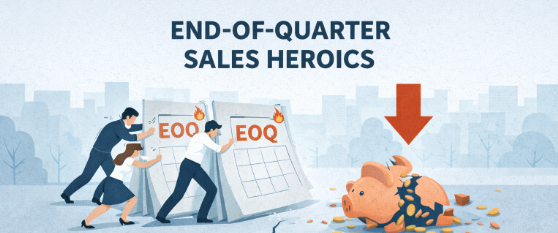
Editor’s Note: Authored by the Oper Hand Insights Desk under the direction of Steve Ross. Every insight is verified against Steve’s 30-year ‘Oper Hand Lens’, acquired in the trenches of B2B startups and scaleups. Content is cross-referenced with sources such as The Wall Street Journal, Forbes, Harvard Business Review, Entrepreneur, and others.
If end-of-quarter sales heroics feel familiar, the system is already telling you something is wrong. Growing businesses do not miss quarters because teams lack effort. They miss because accountability and process arrive late, and pressure fills the gap.
TL;DR
- End-of-quarter sales heroics are not intensity. They are delayed decisions showing up as urgency.
- Panic closes deals at the expense of credibility, margin, and next quarter’s pipeline.
- Growing businesses confuse motion with momentum when pipeline truth arrives too late.
- Strong operators design quarters that surface risk early so pressure never has to spike.
The scramble you recognize immediately
The last two weeks of the quarter hit and everything changes. Forecast calls multiply. Deals that sat untouched suddenly become “must-win.” Discounts appear that were not approved three weeks ago. Leadership attention collapses into deal-by-deal intervention.
None of this is surprising. It is familiar because end-of-quarter sales heroics repeat with precision every ninety days. The pattern feels like execution. It is actually exposure.
Why this matters now for growing businesses
At this stage, survival is no longer the constraint. Consistency is. Investors, senior hires, and even your strongest reps read quarter-end behavior as a signal. If revenue only moves when pressure peaks, the system is not working.
That instability shows up clearly in forecast accuracy. Just 20% of sales organizations achieved forecasts within a 5% margin of projections, while 43% missed their goal by 10% or more, according to The Challenger Sale citing Xactly’s 2024 benchmark data. The gap is not optimism. It is the absence of predictable pipeline truth earlier in the quarter.
Growing businesses do not fail because they lack talent. They fail because late truth forces late action. End-of-quarter sales heroics are the tax you pay for postponing clarity.
What panic actually indicates
Panic is not caused by weak effort. It is caused by pipeline truth arriving too late to influence outcomes. When leadership delays decisions on qualification, pricing boundaries, or deal ownership, urgency shows up downstream.
Sales teams adapt quickly. They learn that real attention comes at the end. They learn to wait. Over time, end-of-quarter sales heroics become normalized behavior rather than an exception.
The hidden cost most CEOs underestimate
The obvious cost is margin. The deeper cost is trust. Forecast credibility erodes when numbers only matter in the final stretch. Reps lose confidence in planning. Leadership loses bandwidth to think beyond the current quarter.
Most damaging, the next quarter starts weaker. Pull-forward deals, rushed concessions, and burned prospects quietly hollow out future pipeline. End-of-quarter sales heroics save the present by stealing from what comes next.
Why growing companies fall into this trap
Founders rely on pattern recognition built during earlier stages. That instinct once worked. Now it delays system discipline. Activity feels controllable when outcomes feel uncertain.
Pressure feels productive. It is visible. It creates motion. But end-of-quarter sales heroics protect comfort, not performance. They let leaders avoid earlier decisions that would surface uncomfortable truths mid-quarter.
What strong operators do instead
They design quarters where urgency never spikes. They decide earlier, not louder. They force pipeline truth by week three and treat risk as a design flaw, not a motivation problem.
Strong operators understand that end-of-quarter sales heroics are a symptom of missing structure. When decision rights are clear and revenue systems surface risk early, pressure dissipates.
The structural fix
Fixing this does not require more dashboards. It requires earlier commitments. Define what must be true by the third week of the quarter. Lock pricing authority. Clarify escalation paths. Force honest stage definitions that cannot be negotiated away late.
When the system works, end-of-quarter sales heroics disappear because they are no longer needed.
Where Growth Catalyst fits
This is exactly where Growth Catalyst operates. It installs a real sales system so revenue does not depend on founder intervention or quarter-end panic. It removes the conditions that make end-of-quarter sales heroics feel necessary by creating clarity, timing, and accountability earlier in the cycle.
Headquartered in Bellevue, WA, with an office in Boulder, CO, we partner with companies looking for a sales execution firm that actually owns results.
The judgment
If the quarter only feels alive at the end, the business is not in control. Panic is not pressure. Panic is proof.