Editor’s Note: Authored by the Oper Hand Insights Desk under the direction of _Steve Ross. Every insight is verified against Steve’s 30-year ‘Oper Hand Lens’, acquired in the trenches of B2B startups and scaleups. Content is cross-referenced with sources such as The Wall Street Journal, Forbes, Harvard Business Review, Entrepreneur, and others.
If growth feels expensive, slow, and fragile, the problem is not just revenue. Operational leverage for growth is what allows strong operators to scale output before they scale payroll.
TL;DR
- Hiring is the most expensive way to fix operational weakness.
- Growing businesses stall when flow breaks, not when effort drops.
- Scale comes from leverage, not labor.
- The fastest growth comes from redesigning decisions, ownership, and execution.
- Operators who fix flow scale cleanly. Everyone else hires to survive.
You do not wake up one morning and decide to scale poorly.
It happens gradually.
Revenue starts coming in more consistently. Customers say yes more often. The business feels busy in a way that is successful from the outside. Internally, however, things start to strain. Decisions slow down. Work gets revisited. You are pulled into more conversations just to keep things moving.
At that moment, most c reach for the same lever.
They hire.
It feels logical. Volume is up. The team is stretched. More people should help.
In most growing businesses, it does the opposite.
Why This Matters Now
The growing business stage is where momentum either hardens into repeatability or collapses under its own weight.
Founder heroics no longer scale. That is expected. What is not expected is replacing founder effort with headcount instead of structure.
This is where operational leverage for growth becomes decisive.
The real limiter is not effort. It is engagement and execution clarity. Gallup estimates that $9.6 trillion in productivity could be added to the global economy if the global workforce were fully engaged, equivalent to a 9% increase in global GDP. That gap exists because most organizations are structurally incapable of converting effort into output once complexity sets in.
Your company is not immune to that math.
The Constraint You Are Misdiagnosing
Most CEOs believe they have a capacity problem.
They do not.
They have a flow problem.
Work does not move cleanly from decision to execution. Ownership is implied instead of explicit. Hand-offs rely on memory and goodwill. Priorities change without consequences. The founder stays involved to prevent failure, only to become the bottleneck.
When flow breaks, output drops. When output drops, hiring feels urgent.
Hiring into broken flow multiplies problems. You add coordination without clarity. You increase cost without increasing throughput.
That is not scale. That is accumulation.
What Operational Leverage for Growth Actually Means
Operational leverage for growth is not abstract.
It means the same team produces more output with less friction.
Not by working harder. By removing drag that never should have existed.
Drag shows up as:
- Decisions waiting on you.
- Work revisited multiple times.
- Meetings that replace ownership.
- Priorities that compete instead of align.
Leverage is created when:
- Decisions move down permanently.
- Ownership is explicit and irreversible.
- Inputs are controlled.
- Outputs are measured.
This is how output compounds without payroll following it.
Where Leverage Is Lost First
In growing businesses, leverage leaks in predictable places.
Meetings replace decisions. The same topics resurface because no one owns the outcome.
The founder stays inside execution. You approve, review, and fix instead of designing the system that prevents errors.
Roles blur under pressure. People stay busy but no one can be held accountable for results.
These are not people problems. They are operating failures.
The CEO Behavior That Slows Everything
Most CEOs confuse proximity with control.
Staying close feels responsible. It feels like leadership.
In practice, it creates dependency.
When decisions that should live below you stay with you, throughput collapses. The organization waits. Teams hesitate. Execution slows in ways you do not see until results lag.
Strong operators redesign decision flow.
They decide once. Then they let the system execute repeatedly.
This is the difference between scaling effort and scaling output.
The Decisions That Unlock Scale Without Hiring
There are three categories of decisions every CEO must confront.
Decisions that move down.
If a decision happens more than twice, it does not belong to you.
Decisions that disappear.
If a decision does not materially change outcomes, eliminate it entirely.
Decisions you must stop owning.
If the business cannot function without your involvement, you do not have leverage. You have risk.
Each shift increases operational leverage for growth without adding cost.
Efficiency Is Not Cost-Cutting
Efficiency is not about squeezing people.
Efficiency optimization is about removing friction so effort converts into results.
That means:
- Clear roles.
- Tight hand-offs.
- Fewer decisions.
- Faster execution.
When done correctly, output increases without burnout. Quality stabilizes. Leaders emerge. Hiring becomes intentional instead of reactive.
This is why efficiency compounds faster than headcount.
What Strong Operators Do Differently
They redesign flow before adding people.
They clarify ownership instead of adding oversight.
They measure throughput instead of activity.
They stop rewarding busyness and start rewarding completion.
They understand that scale is an operating problem long before it is a staffing problem.
The Compounding Advantage Over 12 Months
Fixing operations early creates leverage that compounds.
You grow without bloating costs. You hire into clarity instead of chaos. You reduce key-person risk. You build a leadership bench investors trust.
Clean operations signal discipline. Discipline signals control. Control increases valuation.
Most CEOs chase growth and hope operations catch up.
Strong operators reverse that order.
The Hard Truth
If you are hiring to keep up, you are already behind.
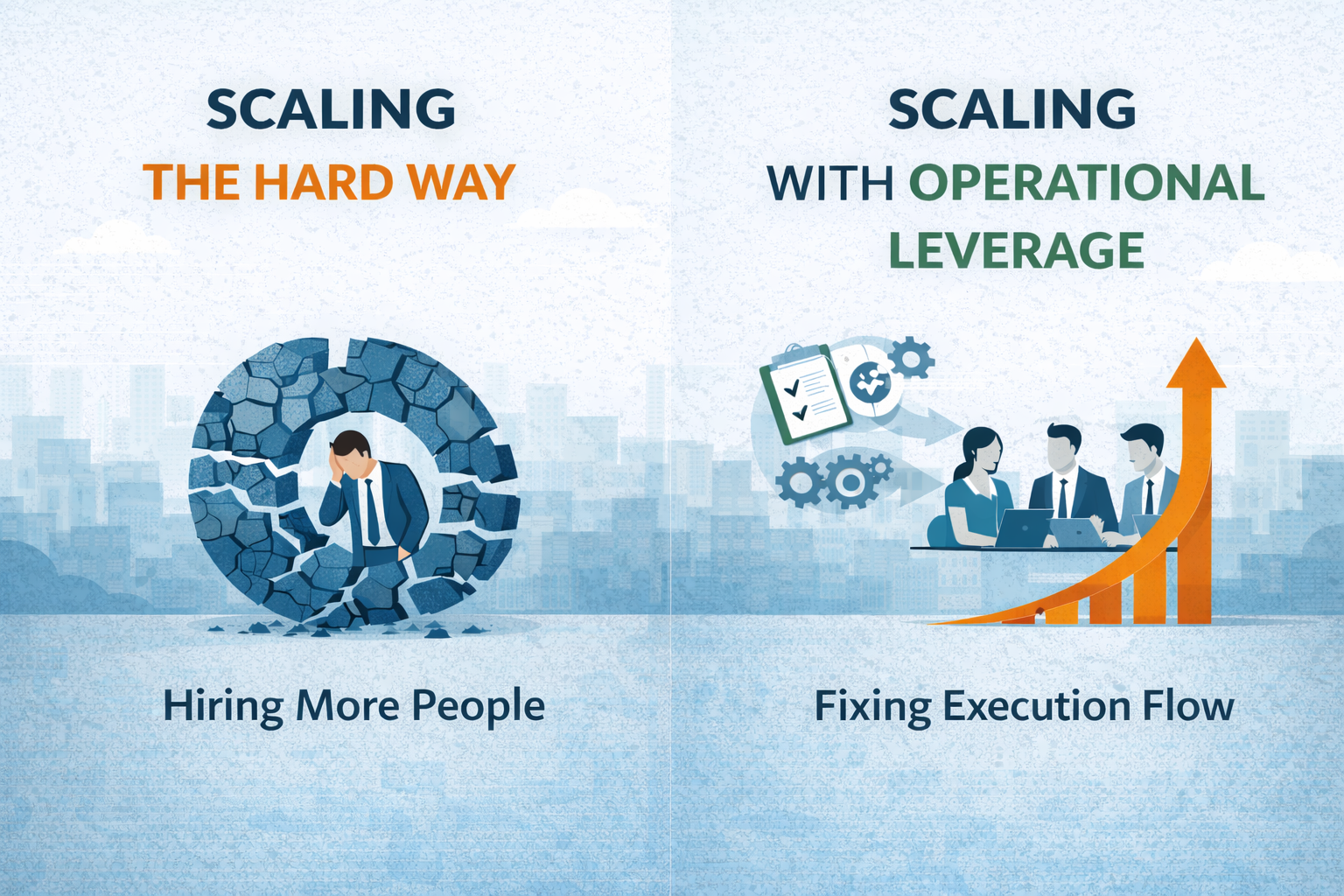
Scaling the hard way feels productive. It also makes the business expensive, fragile, and slow.
Scaling through operational leverage for growth feels uncomfortable. It forces you to confront how decisions are made, how work actually moves, and where control truly lives.
That discomfort is the price of real scale.
Headquartered in Bellevue, WA, with an office in Boulder, CO, we install the revenue and operations systems that generate revenue, not burn it. We help your company develop operational leverage for growth. If you’re ready to optimize your sales process and drive real growth, let’s talk.