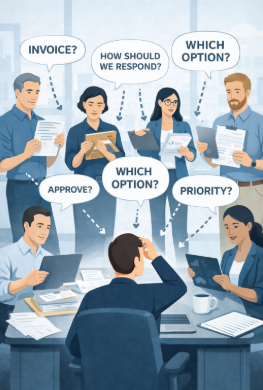
This article is written for founders and CEOs who have already found traction but wonder why does my team depends on me for every decision. Revenue is coming in, the team is capable, and nothing appears obviously broken. Yet execution feels heavier each quarter, and more decisions seem to require direct CEO involvement than before.
At this stage, many founders start asking a quiet but persistent question: why does my team depend on me for every decision?
The common explanation is people. Weak managers. Inexperience. Lack of accountability.
The common response is more involvement. More reviews. More approvals. More founder time in the middle of execution.
TL;DR
- Startup output stalls when the founder becomes the throughput limit.
- The founder output constraint hides behind effort, speed, and good intentions.
- Stepping back works only when decision flow is redesigned, not abandoned.
- Strong founders stop being necessary before the company is ready.
You feel it before the numbers prove it.
Decisions wait for you.
Questions stack up in your inbox.
Execution slows even though everyone looks busy.
Nothing is broken. Revenue exists. Customers are paying. The product works well enough. But progress feels capped. You work longer hours and still wake up behind.
At the startup stage, this is the moment most founders misdiagnose. They assume the answer is more involvement. More checking. More jumping in. More fixing.
That instinct creates the founder output constraint.
Why This Matters Now
This problem shows up after early traction, not before it.
Before traction, involvement is survival. Speed matters more than structure. Control keeps the company alive.
After traction, the same behavior becomes a limiter.
At a startup, output is not defined by effort. Output is defined by how fast decisions move without you. When every path runs through the founder, the company inherits a ceiling.
You are not failing at leadership. You are succeeding at execution past its expiration date.
The why “my team depends on me for every decision” issue is when your presence becomes required for momentum instead of optional for quality.
The team depends on me for every decision
A constraint is the single limiting factor that caps system performance.
In early startups, the constraint is usually cash, product fit, or demand.
Once those stabilize, the constraint shifts. It becomes decision velocity. And the founder sits directly in the middle of it.
The founder output constraint appears when:
- Work waits for approval instead of flowing by design.
- Team members optimize for access to you instead of ownership.
- You are involved in decisions that no longer need your judgment.
You feel productive because you are busy. The company feels slower because it is waiting.
This is not a delegation problem. It is a system design problem.
The Control Trap Disguised as Leadership
Most founders do not cling to control out of ego. They do it out of responsibility.
You built this. You know where the risks are. You have seen what happens when small mistakes compound.
So you stay close.
You review before things ship.
You answer questions quickly.
You fix issues faster than anyone else.
It feels like leadership.
In reality, it trains the organization to wait.
Every time you step in, you reduce uncertainty for yourself and increase it for everyone else. The team learns that decisions are safer when escalated. Ownership shrinks quietly.
This pattern is not theoretical. Deloitte Insights found that high-performing organizations are 22 times more likely to openly discuss how decisions will be made and nine times more likely to teach decision-making skills. The signal is clear. Output scales when decision clarity replaces founder proximity.
The team depends on me for every decision challenge stops when you stop it.
When Stepping Back Increases Output
Stepping back only works under specific conditions.
Distance alone creates chaos. Absence without structure creates drift.
Output increases when stepping back is paired with clarity.
This happens when:
- Decision rights are explicit.
- Ownership is named, not implied.
- Escalation paths are narrow and intentional.
When people know what they own, speed replaces hesitation.
When they know which decisions are theirs, approval loops disappear.
When they understand consequences, quality improves without oversight.
You can feel relief when you can finally say that your team no longer depends on me for every decision.
Redesigning the Founder Role
The shift is not from doing to delegating. It is from reacting to designing.
The first step is subtraction.
Stop being the fallback.
Stop answering questions that someone else should resolve.
Stop correcting work that meets the standard but not your preference.
Then replace presence with structure.
Define what good looks like in writing.
Assign decision ownership with clear scope.
Set review points instead of constant access.
You will feel like my team depends on me for every decision for as long as you substitute availability for clarity.
Installing the Founder Flywheel
This is where the Founder Flywheel matters.
The Founder Flywheel is not about stepping away. It is about redesigning how decisions move so the company does not depend on you to function.
The flywheel works by:
- Breaking key-person dependency.
- Rebuilding decision flow around roles, not personalities.
- Creating leaders with real ownership, not task lists.
As decisions move down, execution speeds up. As execution speeds up, you regain strategic altitude. As altitude increases, output compounds.
This is how stepping back increases output without losing control.
The Judgment Moment
Every startup reaches a point where the founder must choose between being essential or being effective.
Staying essential feels safer. It feels earned. It feels responsible.
It also caps growth.
Becoming non-required feels uncomfortable. It exposes gaps. It forces trust before comfort.
Strong operators choose to remove themselves as the bottleneck before the market forces the issue.
The founder output constraint does not break on its own. It breaks when the founder decides that the company matters more than their involvement.
Headquartered in Bellevue, WA, with an office in Boulder, CO, we work with companies searching for scaling support before chaos becomes culture.