
TL;DR
- Accountability systems for scaling teams are not a culture initiative. They are an engineering problem.
- When accountability still routes to the CEO, the system is broken, not the people.
- Your leaders are not failing you. The structure you gave them is failing them.
- Ownership without decision rights is a trap. You set it, and your leaders walked into it.
- Three components determine whether accountability lands or loops. Most companies have none of them.
Leadership and team management break down when accountability exists without authority and ownership. Managers manage tasks. Decisions bottleneck at the top. The CEO stays in the middle of every conversation that should have ended two levels down. This post names why that happens at scale and builds the structural fix.
Most CEOs scaling past 50 people have the same experience. They promoted their best operators into leadership roles. They held kick-off meetings. They set goals. They talked about ownership in all-hands sessions. Then six months later, they are still the ones closing the loop on decisions their VPs should have resolved in a Tuesday standup. The accountability is announced. The accountability does not stick. The reason is not culture. The reason is architecture.
Gallup research published in March 2026 found that creating accountability ranks as the single lowest-rated competency among leaders surveyed across industries, and that managers are even more skeptical of their own leaders’ ability to hold teams accountable than the leaders themselves are. The finding matters because it confirms what scaling CEOs already feel but rarely name: accountability is not a mindset gap at scale. It is a structural gap. Building accountability systems for scaling teams starts with accepting that truth. You cannot train your way out of a design problem.
What Accountability Actually Requires at Scale
Accountability at 10 people is personal. Everyone sees everything. Gaps are visible. The founder fills them. That model works until it does not, and the moment it breaks is not when you hit 20 people or 50 people. It breaks the first time a decision requires two people who do not share the same hallway to agree on something without the founder in the room. At that point, accountability needs a system to travel through. Without one, it dissolves.
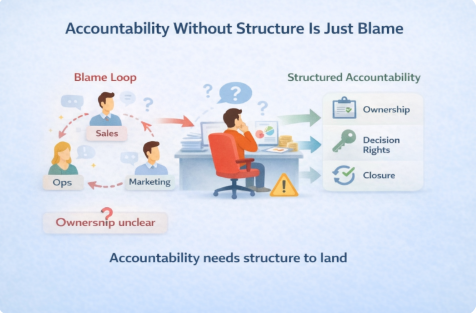
Accountability systems for scaling teams require three structural conditions. First, someone must own the outcome, not just the task. Second, that person must have the decision rights to control the outcome. Third, the organization must have a mechanism that confirms a decision landed once and stayed landed. Most companies have clarity on tasks. Almost none have clarity on outcomes, decision rights, or closure. This is why accountability conversations happen repeatedly about the same issues.
Why Good Leaders Still Drop the Ball
The leaders you promoted did not become less capable when you gave them a title. They became less capable when you gave them responsibility without the structural support to hold it. Accountability systems for scaling teams exist to carry that weight so your leaders do not have to improvise it. Without the system, accountability without decision rights becomes an impossible position. You are asking someone to own a result they cannot control. When they fail, you call it a leadership problem. It is an architecture problem.
Consider what happens in most scaling companies when a cross-functional decision needs to land. The VP of Sales needs a pricing exception approved. The VP of Operations needs to know if the product team will hit the delivery date. The Head of Marketing needs a budget call from finance. Each of those situations requires a decision to travel across a boundary. If no one has explicit authority to make that call at the boundary, the decision routes up. It routes to you. You become the junction box for every decision your organization cannot resolve on its own, and you wonder why you are still in every meeting.
The Accountability Architecture Framework
Accountability systems for scaling teams work when three components operate together. The first is Ownership Clarity. This defines who holds the outcome, not who completes the task. A task owner delivers an action. An outcome owner answers for the result. When a project slips, the outcome owner does not explain what went wrong. The outcome owner fixes it. The distinction sounds small. The operational difference is enormous. Without it, every post-mortem becomes a tour of who did what instead of a conversation about what changes next.
The second component is Decision Rights. This defines what level of the organization resolves what category of decision. Decision rights do not mean autonomy without limits. They mean explicit, documented authority. Your VP of Sales knows which deals they can discount without escalation. Your Head of Operations knows which vendor relationships they can terminate. Your finance lead knows which budget variances require executive sign-off. When decision rights are ambiguous, every decision becomes a judgment call about who gets to make it, and that judgment call routes to the most senior person available, which is almost always you.
The third component is Closure Loops. A closure loop is the mechanism that confirms a decision landed once and stayed landed. Most organizations make decisions in meetings and then remake them in the next meeting because nothing in the system captures the original resolution and makes it visible. Closure loops are not meeting notes. They are operational checkpoints embedded in the cadence of the business. A weekly leadership review that opens with last week’s decisions and confirms their status is a closure loop. A project management system that marks a decision as resolved and routes exceptions rather than reopening everything is a closure loop. Without this, accountability exists only in the room where the decision was made. The moment someone walks out, the decision starts to dissolve.
The Three Decisions CEOs Must Stop Making Themselves
Accountability systems for scaling teams reveal three categories of decisions that CEOs make themselves when they should not. Each one belongs at a lower level. Each one staying at the top is a signal the architecture is missing.
The first is cross-functional prioritization. When two departments disagree on sequencing, that conflict belongs at the VP layer, not yours. Build a decision rights matrix that defines who resolves inter-departmental disputes at each level, and enforce it.
The second is exception approval. Pricing exceptions, budget variances, timeline adjustments, these decisions are not strategic. They are operational. When they route to the CEO, it signals one of two things: either decision rights are not documented, or leaders do not trust they have the authority to use them. Both are fixable. Document the authority. Then honor it when your leaders use it.
The third is performance conversations. When a manager does not perform, the CEO should not be the one who initiates accountability. That conversation belongs to the leader who owns that manager’s outcomes. If your leaders cannot hold their own direct reports accountable without your involvement, you have a delegation problem, not a performance problem. The fix is structural: give leaders the tools, the authority, and the expectation to hold the line themselves.
What Changes When the System Holds It
Accountability systems for scaling teams do not eliminate conflict. They route conflict to the right level. When ownership is clear, disputes become conversations between the people who own adjacent outcomes. When decision rights are documented, escalation becomes the exception instead of the default. When closure loops are embedded in the operating cadence, decisions land once and execution accelerates.
The metric that tells you the system is working is not engagement scores or survey results. It is decision latency. Measure how long it takes for a decision to travel from the person who identifies the need to the person who resolves it. When that number drops, your organization is running on structure. When that number climbs, accountability has routed back to you, and you are the bottleneck again.
Headquartered in Bellevue, WA, with an office in Boulder, CO, Oper Hand installs the revenue and operations systems that generate revenue, not burn it. The Efficiency Enhancer engagement is built specifically for scaling companies that need to clarify roles, tighten decision rights, and reduce the decision latency that slows execution. If you are ready to optimize your operations and drive real growth, let’s talk.
The question worth sitting with is not whether your leaders are accountable. The question is whether your organization gives accountability anywhere to land. If the answer is no, the structure is the problem, and the structure is yours to fix.