
TL;DR
- A complex B2B sales cycle, too long to forecast, is not a buyer problem. It is a system problem your team has not built yet.
- Most Growing Business pipelines are full of deals that will never close, and the CRM numbers hide it.
- When your sales team holds one contact inside a buying group of seven, you do not have a deal. You have a conversation.
- Multi-stakeholder deals do not stall because buyers lose interest. They stall because no one on your side owns the next committed move.
- The founder closed deals on relationship and force of will. That era is over. What replaces it is a repeatable system, not more hustle.
Leads and pipeline breaks when there is no full-funnel rigor or truth in the numbers, and right now, your pipeline is telling you a story your forecast cannot afford to believe. You have seen it in your own review calls. Deals sitting in the same stage for three weeks. A rep who reports the opportunity is “still active” but cannot name the buyer’s next internal approval step. A close date that slides to the next quarter, then the quarter after. That gap is not bad luck. It is the absence of a system designed to drive a complex B2B sales cycle to a decision.
This matters more at the Growing Business stage than at any other point in your company’s life. You got here because you, the founder, closed deals. You knew every account. You sat in the room. You felt when a deal was dying, and you intervened. That approach worked when you had twelve accounts and infinite personal bandwidth. It does not scale to 40 accounts across a team of three reps, each handling multiple opportunities at different stages with different buying groups. The complex B2B sales cycle, too long to manage personally, is now the norm across your entire pipeline. And because no one built a system to replace your judgment, every deal runs on instinct and hope instead of structure and data.
What a Lying Pipeline Actually Looks Like
The clearest signal that your pipeline has stopped being a management tool is when your forecast calls become theater. Everyone reports progress. Nothing closes on schedule. You hear phrases like “they are still evaluating,” “waiting on legal,” and “the champion is aligned, just needs sign-off.” Each one sounds like movement. None of them represents a committed next step from the buyer’s side. According to Forrester’s State of Business Buying report, 86% of B2B purchases stall at some point during the buying process. That number does not reflect bad markets or weak products. It reflects pipelines where deals are tracked by seller activity rather than buyer behavior. Your CRM shows what your reps did. It rarely shows what the buyer decided. When those two things become disconnected, your pipeline number becomes a fiction your team presents to you each week.
The problem compounds as your team grows. When you were closing deals yourself, you had direct access to buyer signals. You felt resistance. You heard hesitation. Now you receive secondhand reports filtered through reps who are under their own quota pressure and have their own interpretation of what “progressing” means. A deal that should have been disqualified ninety days ago is still sitting in your forecast because no one has the process or the permission, to call it dead. Your complex B2B sales cycle too long to close is not the result of difficult buyers. It is the result of a pipeline with no exit criteria, no stage discipline, and no system that forces truth to the surface.
Why Complex Deals Stall at the Growing Business Stage
The transition from founder-led sales to a team-managed pipeline creates a structural vulnerability that most Growing Businesses do not see until revenue growth flattens. Your early deals closed because you built relationships at the top and navigated complexity personally. Your team does not have that relationship capital yet. More importantly, they are almost certainly underpenetrated inside each account. The typical B2B buying group for a mid-sized company involves an average of seven stakeholders, each with different priorities, different concerns, and different approval requirements. Your rep has one contact. That contact may be an influencer with no budget authority. The deal stalls not because the buyer said no, but because the right people inside the buying organization never said yes.
The danger at the Growing Business stage is that your reps mistake activity for progress. They send follow-up emails. They book check-in calls. They update the CRM. None of that moves the deal closer to a decision if your team is not engaged with the people who hold budget authority and sign-off power. Meanwhile, 28% of sales reps cite a sales process that takes too long as the primary reason prospects back out entirely. The complex B2B sales cycle too long is not killing your deals at the finish line. It is killing them in the middle, quietly, while your reps report everything is fine.
The Multi-Stakeholder Coverage Framework
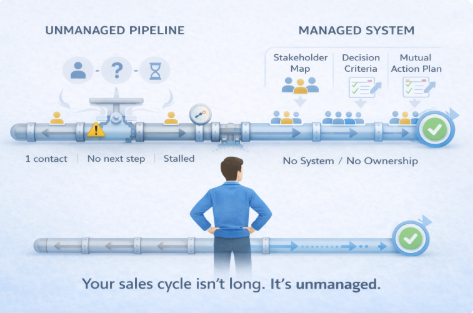
Fixing this requires a structured approach to how your team maps and manages every active opportunity. The Multi-Stakeholder Coverage Framework operates across three components that must be applied to every deal in your pipeline before it advances past the discovery stage.
The first component is the stakeholder map. For every active opportunity, your rep must identify every person involved in the buying decision, by name, title, and role in the decision. Economic buyer, technical evaluator, legal reviewer, end user champion, and any executive sponsor who can accelerate or kill the deal. If your rep cannot name those people, the deal does not advance. A blank stakeholder map is a disqualification signal, not a follow-up task.
The second component is decision criteria alignment. Your team needs to know, explicitly, in writing, what each key stakeholder is evaluating and what a successful outcome looks like to them individually. The economic buyer cares about ROI and risk. The technical evaluator cares about integration and implementation load. The end user cares about adoption and workflow disruption. Selling one message to all of them is how deals die in committee. When your rep has mapped each stakeholder’s criteria, they can build the internal case the buyer needs to get consensus across a buying group that will never all be in the same room with your team at the same time.
The third component is the mutual action plan. Every deal in your pipeline must have a written, buyer-confirmed sequence of next steps with dates, owners, and decision gates. Not a list of things your rep plans to do. A shared document the buyer has agreed to that maps the path from where you are today to a signed agreement. When buyers agree to a mutual action plan, they are not just engaging, they are committing. When they refuse to commit to a plan, that is the most useful piece of information your team can gather. It means the deal is not real yet, and your forecast should reflect that.
What Full-Funnel Rigor Requires
Applying the Multi-Stakeholder Coverage Framework at the deal level is necessary. It is not sufficient. You also need pipeline discipline at the organizational level that makes truth the default output of every review conversation. That starts with stage definitions that are based on buyer behavior, not seller activity. A deal does not advance to proposal stage because your rep sent a proposal. It advances when the buyer has confirmed the problem, the stakeholders have been mapped, the decision criteria are documented, and a mutual action plan is in place. Stage gates with real exit criteria transform your pipeline from a storage system into a management tool.
Your pipeline review cadence needs to change as well. The questions that surface truth sound different from the ones that generate theater. Instead of asking “where does this deal stand,” ask your reps to name the economic buyer, describe the last action the buyer took, and read the next committed step from the mutual action plan. Those three questions will tell you everything the CRM does not. The complex B2B sales cycle too long to manage through weekly check-ins becomes manageable when your review process is built around buyer behavior rather than rep confidence. Forecasts stop being optimistic projections and start being signals you can actually act on.
CEO-Actionable Decisions
You can make three decisions this week that change the trajectory of your pipeline immediately.
- First, audit every deal in your current forecast against the stakeholder map requirement. Any opportunity where your rep cannot name the economic buyer and at least two additional stakeholders gets flagged. You are not killing those deals. You are identifying where your team needs to go do the work before the deal moves forward. Every day you allow a complex B2B sales cycle too long to close to remain unexamined in your forecast is a day your team is working on deals that will never convert.
- Second, run one pipeline review using the three-question format above. Name the economic buyer. Describe the last buyer action. Read the next committed step. Do it for every deal in the current quarter. What surfaces in that conversation is the real state of your pipeline, not the version your CRM is showing you.
- Third, require a mutual action plan as a stage-gate requirement for every deal above your minimum deal threshold. If the buyer will not commit to a shared plan, that deal does not count as a qualified opportunity. It goes back to the top of the funnel or gets disqualified. This single requirement will compress your complex B2B sales cycle and clean out the phantom revenue that is distorting your forecast.
Building the System That Replaces Founder Instinct
The revenue system you need at the Growing Business stage does not run on your judgment. It runs on process, stage discipline, and buyer-behavior data that any rep on your team can execute consistently. When that system exists, your pipeline reflects reality. Your forecast becomes a tool instead of a ritual. And your sales cycle length reflects the complexity of your buyers, not the absence of structure on your side.
Oper Hand’s Growth Catalyst engagement is built for founders at exactly this stage, the point where the pipeline has outgrown personal management and the system has not been built to replace it. We identify the constraint that is extending your complex B2B sales cycle too long to forecast and install the structure that drives deals to decisions without founder intervention.
Your pipeline right now is a reflection of every sales process decision you have not made yet, and every day the complex B2B sales cycle too long to forecast continues, that cost compounds. The deals that are stalling are not waiting on buyers. They are waiting on you to build the system that gives your team a real path to close.