
TL;DR
- The founder bottleneck slowing company growth is not a capacity problem. It is a design problem.
- Every decision that you is momentum for your company that cannot recover.
- You believe your involvement is what keeps quality high. Your team believes it is what keeps them stuck.
- Breaking founder dependency requires redesigning how decisions move through your company, not how hard you work.
- The companies that break through this stage build systems that generate results whether or not the founder is in the room.
Business strategy and pivoting break down when the founder remains the central decision-maker past the point where the company can afford it. The founder bottleneck slowing company growth does not announce itself. It shows up as deals that stall while your calendar fills, hires that underperform because no one told them what ownership actually means, and strategy conversations that cannot begin until you arrive. This post is about how to break that pattern before it becomes permanent.
Your company is growing. Revenue is consistent. The team is larger than it was two years ago. By most measures, things are working. The problem is that the thing generating growth is still you. You are still the one who closes the important deals, resolves the operational disputes, makes the calls that unblock the team, and holds the strategic context that no one else fully has. That was the right model at fifteen people. At forty, fifty, or seventy-five, it is the ceiling on everything you are trying to build. According to McKinsey research, organizations in the top quartile of leadership effectiveness generate EBITDA nearly double that of their peers. The gap between a company running on distributed leadership and one running on the founder bottleneck slowing company growth is not a matter of degree. It is structural.
The Signal You Are Missing
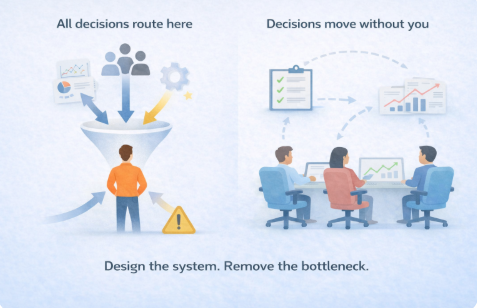
The founder bottleneck slowing company growth rarely looks like failure. It looks like you being good at your job. You jump in on a deal that was stalling and it closes. You make a call on a hiring decision and the right person gets the offer. You show up to a delivery problem and it gets resolved. Every one of those interventions feels like contribution. Every one of them also teaches your team the same lesson: wait. Do not escalate through a process. Do not own the decision. Wait for the founder, because the founder will eventually show up and make it right.
The behavioral signals are concrete. Your team brings you problems rather than solutions. Meetings without you either do not happen or do not produce decisions. Your opinion, once offered, ends the conversation rather than advancing it. Projects that touch multiple functions move at the speed of your availability. None of these are personality failures in your team. They are rational adaptations to a system where the founder is the decision hub and everything else is a spoke. You built that system around the founder bottleneck slowing company growth. You are the only one who can redesign it.
Why Smart Founders Stay Stuck
The founders who stay in this pattern the longest are not the ones who lack self-awareness. They are the ones who are genuinely excellent operators. They are fast, decisive, and usually right. That competence is the trap. When you are reliably better at a decision than anyone else on your team, removing yourself from that decision feels like accepting a worse outcome. And in the short term, it often is. The person you hand the decision to will get it wrong more often than you would. That short-term cost is real. The founders who break through it understand that the cost of staying central is higher, compounding, and invisible until it is not.
There is also an identity component that does not get named enough. Your company is your creation. Your judgment built it. Your relationships opened the early doors. The business running without you feels less like freedom and more like irrelevance. That feeling is not weakness. It is a very normal response to handing over what you spent years building. But it is also a signal worth examining. If your company cannot make decisions without you, it is not a sign that you are indispensable. It is a sign that you have not yet built what you set out to build.
The Decision Redesign: The Founder Flywheel
The Founder Flywheel is not a delegation checklist. It is a redesign of how decisions move through your company, where accountability lives, and what your role actually is at this stage of growth.
It operates on three moves.
- The first is decision mapping. You identify every category of decision that currently routes through you and ask a single question: what would need to be true for this decision to be made without me? That question forces specificity. It is not enough to say you need to trust your team more. You need to know what information they are missing, what authority they do not have, and what process does not exist that keeps the decision coming back to you.
- The second move is authority transfer. Most Growing Business founders have given their team responsibility without giving them authority. That is a setup for failure. Responsibility without authority means the person owns the outcome but not the levers. They will either make the decision anyway and feel exposed when it goes wrong, or they will wait for you. Authority transfer means defining decision rights explicitly: who decides, who needs to be informed, and what requires escalation. When those lines are clear, decisions move.
- The third move is the founder role reset. Your job at this stage is not to make decisions. It is to build the system that makes decisions. You show up to define direction, to raise the capability of the people around you, and to handle the small category of choices that genuinely require your judgment. Everything else is a tax on your company’s growth that only you can remove.
What Changes When You Remove Yourself
The outcomes of breaking founder dependency are not abstract. Speed increases because decisions no longer queue behind your availability. Talent retention improves because capable people stay in environments where they have real ownership. Investor confidence strengthens because a company that runs on systems rather than personality carries fundamentally lower key-person risk, which translates directly to valuation. The deals you are trying to close, the growth you are trying to capture, and the team you are trying to build are all downstream of a single structural change: designing a company that does not need you in the room to move forward.
Your best people already know whether your company is founder-dependent. They experience it every day. The ones who stay despite it are either not good enough to have better options, or they are waiting to see if you are going to change the design. Most founders discover which it is too late.
The Moves That Break the Pattern
Breaking the founder bottleneck slowing company growth requires three concrete decisions made in sequence.
- First, conduct a decision audit. For two weeks, log every decision that comes to you. Note the category, the person who brought it, and whether a clear process or authority structure existed for it. You will find that most decisions route through you not because they require your judgment but because the system has no other path. That audit is your redesign roadmap.
- Second, transfer one complete decision domain in thirty days. Pick the category with the highest volume and the lowest actual strategic stakes. Define the decision rights explicitly. Assign ownership. Remove yourself from the approval chain entirely. Do not review the decisions afterward. Let the owner live with the outcomes. Your job for thirty days is to resist the pull to re-enter.
- Third, rewrite your calendar to reflect your actual job. If your calendar shows you in operational reviews, deal-specific sales calls, and delivery troubleshoots, your calendar is telling you what your company thinks your job is. Reset it. Block the time for direction setting, leadership development, and the handful of decisions that genuinely belong to you. Protect that structure against the daily pressure to step back in.
The founder bottleneck slowing company growth is exactly what the Founder Flywheel is designed to remove. It is one of the core engagements we run with Growing Business CEOs who have hit this ceiling. We redesign how decisions move, clarify where ownership lives, and remove the founder from the center of a machine they built but were never supposed to run forever. If you are ready to optimize your sales process and drive real growth, let’s talk.
The founder bottleneck slowing company growth does not resolve on its own. If you still make every important decision in your company, you have not built a business that scales. You have built a sophisticated dependency with a payroll attached to it. The question is not whether you are capable of changing the design. You clearly are. The question is whether you will do it before your best people stop waiting and your growth ceiling becomes permanent.