
TL;DR
- The boardroom is where CEO board mistakes get made. Most CEOs walk out having presented well. The company pays for it three weeks later.
- Business strategy breaks when teams accelerate execution before the board has committed to anything.
- The meeting felt productive. The questions were sharp. Then nothing moved.
- The gap between what the board nods at and what anyone owns afterward is where scaling companies stall.
- One structural shift closes that gap before the next meeting starts.
The most expensive CEO board mistakes happen in the boardroom.
The CEO presents a compelling deck. The board asks sharp questions. Everyone leaves feeling good about the session. Three weeks later, nothing has moved. The initiative has no owner. The board is waiting for more data. The CEO is back in the middle, manually pushing decisions that should have been settled in that room.
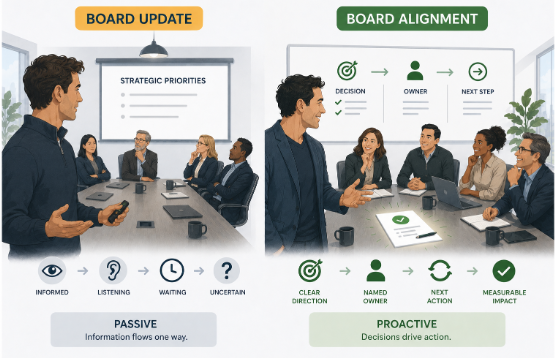
The board approved the update. They left as informed observers. Same session. Completely different company trajectory afterward.
CEO board mistakes compound fastest when the CEO treats this as a communication problem. It is a structural one. The CEO still drives the session. But whether the board holds formal investor seats or operates as an advisory group, it carries real leverage. It can push back on direction, slow approvals, and demand results before the next move. That leverage does not disappear because the structure is informal. Any group with access to the CEO and opinions about company direction will use them. The CEO who manages that dynamic proactively controls it. The one who shows up to report loses it.
A 2025 PwC and Conference Board survey of more than 500 C-suite executives found that only 35% rated their board’s effectiveness as excellent or good. The gap between boards and the executives who lead them keeps growing. That gap belongs to the CEO. The CEO owns the dynamic in that room.
CEO Board Mistakes That Look Like Progress
A board update transfers information. It shows progress. It invites questions. Done well, it builds credibility. Done consistently, it trains the board to show up as an audience.
They listen. They probe. They leave informed.
An informed board member and an aligned board member look identical in the room. Same questions. Same nods. The difference shows up three weeks later, when one acts and the other waits for the next update.
Running updates instead of alignment sessions is one of the most common mistakes CEOs make on boards at scale. The reason it persists: updates feel like work. The room was engaged. The deck was strong. The questions were sharp. The company still has no committed direction when everyone walks out.
Managing perception is a reasonable objective at an early stage. At scale, it is the wrong game. When the stakes are real and capital is in motion, the company needs owners in that room. People who are committed to a direction and will push the weight of their position behind execution.
What Board Alignment Requires
Alignment starts with a question. One question. Written before the CEO walks in the room.
The question has a binary answer. It produces a named owner and a clear next action when the answer lands. It demands a commitment before the session ends.
Most CEOs sidestep this because it forces clarity they are unprepared to defend. Presenting a direction is safe. Asking the board to commit to it is exposed. A no requires reckoning with that in the room. A yes requires delivering against it. Both outcomes require accountability running in both directions. The CEO owns the ask. The board owns the answer. Everyone leaves knowing exactly what happens next.
The Pre-Meeting Work Most CEOs Skip
The work happens before you walk into the room.
Skipping it is one of the quieter CEO board mistakes. It surfaces three weeks after the session when nothing has moved, and nobody can explain why.
The CEOs who consistently leave board sessions with firm decisions work the room before entering the meeting. They identify which members hold the most influence on the specific question being decided. They schedule individual conversations in the two weeks leading up to the meeting. They surface objections privately, address them directly, and arrive knowing exactly where each person stands.
Walk into a major sales meeting without working the deal first. See what happens. Present a key hire to the leadership team without pre-selling the decision to your top operators. See what happens. The board is the same dynamic. Alignment gets built in the two weeks before. The meeting is where it lands.
The Alignment Frame
Most CEOs walk into board meetings with a deck. The Alignment Frame replaces the deck dynamic with a decision dynamic. Three parts. Applied before, during, and after every board interaction. It directly addresses the CEO board mistakes that cause execution to stall after sessions that felt productive.
- Part One: The Committed Question
-
-
- Before every board session, write down the single decision that must be made in this meeting. One question. Binary answer. When the answer lands, a clear next action follows automatically. If the CEO cannot write that question before the meeting, the meeting is ineffective.
-
- Part Two: The Named Owner
-
-
- Every committed decision gets a specific person attached before the meeting ends. A board member if the decision lives at that level. An executive if it lives in the company. That name goes into the follow-up summary within 24 hours. Unnamed ownership means the decision will resurface in six weeks with no progress and a fresh set of excuses.
-
- Part Three: The Consequence Trigger
-
- Every committed decision needs a defined condition that forces a revisit. Capital deployed and the metric missed by a specific date: the decision comes back to the board. Initiative misses its first milestone: the owner returns with a recommendation. The trigger tells everyone in the room that their alignment carries weight. The CEO will hold the company to what was decided.
What Changes When You Get This Right
Three shifts happen when the CEO runs every board interaction through the Alignment Frame.
- The board becomes a decision-making body. The engagement changes because the stakes of their involvement are real. Directors who know their alignment carries consequences show up differently. They come prepared. They push harder in the room. They follow through after it.
- The execution team receives a clear signal from the top. A board that is committed to a direction gives the CEO something to communicate with force. Everyone knows direction carries weight. Teams stop hedging. Resources stop splitting. The company moves with the kind of clarity that is impossible to manufacture from the top down.
- And the CEO stops re-selling decisions that were already made. Re-opening closed decisions is one of the most expensive habits in a scaling company. It burns time, erodes credibility, and signals to the team that direction is negotiable. Board alignment ends it.
CEO-Actionable Decisions
Three moves. Apply them to the next board meeting.
- Before: Write one Committed Question. Prioritize ruthlessly if more than one exists. A board that commits to a single decision outperforms a board that reacts to five updates every time.
- During: Drive to the answer before the session ends. Follow-up is where decisions go to die.
- After: Send a written summary within 24 hours. Decision made. Owner named. Consequence trigger set. That document is the accountability mechanism. It trains the board that sessions produce outcomes.
The Real Ceiling
Managing perception in board meetings works at an early stage. At scale, it becomes the ceiling.
Every quarter spent reporting to the board instead of leading them is a quarter where the company’s momentum depends on the CEO being in the room. The board approved the deck. Nobody moved after. CEO-level board mistakes are the most expensive kind. They compound quietly until a pivot feels like an emergency and a missed quarter becomes a missed year.
Board alignment is the difference between a company that scales and a CEO who can leave the room.