
TL;DR
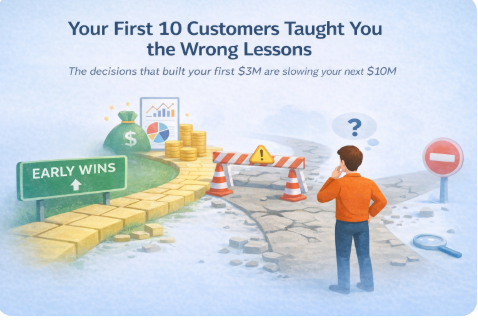
- The decisions that built your first $3M are the same decisions slowing your next $10M.
- Early wins don’t validate your strategy. They validate one moment in time.
- Most growing companies aren’t stuck because of what they’re doing wrong. They’re stuck because of what they stopped questioning.
- The founder who keeps running the play that worked is the founder who caps the company.
- Early wins distorting business strategy is one of the quietest ways a growing business stalls.
Business strategy and pivoting breaks when teams cannot tell the difference between an idea and a decision. Early wins distorting business strategy rarely looks like chaos in a growing business, it looks like confidence. The team moves fast, revenue is real, and the strategy feels proven. What’s actually happening is that the early wins have stopped being inputs and started being conclusions. The company is no longer building toward something. It’s defending something. And the CEO is the last one to see it.
The growing business stage is where early wins distorting business strategy does the most damage. You are no longer fighting for survival the way a startup does. You have repeatable revenue, a team that functions, and customers who return. But those same signals that confirm you have made it past the hardest part also make it harder to question what got you there. Your first ten customers had specific needs, specific budgets, and specific reasons they chose you. They were a sample, not a market. The lessons they taught you were real inside that sample. Outside it, they were a hypothesis you stopped testing the moment the checks cleared.
Research from Wharton professors Saerom Lee and J. Daniel Kim, published in the Strategic Management Journal in 2024 and studied across more than 38,000 U.S. startups, found that founders get excited by early validation of proof of concept, then prematurely double down, but that early validation often ends up being not scalable. The study found that companies scaling within six to twelve months of founding are 20% to 40% more likely to fail. The mechanism is not a lack of ambition. It is a failure to separate what worked from why it worked, and then treating the former as permanent when only the latter was ever real.
What Early Wins Actually Prove
An early win proves one thing: that your offer resonated with a specific buyer, in a specific context, at a specific point in time. It does not prove that your pricing model is right for your next market segment. It does not prove that your delivery process scales beyond your current team size. It does not prove that the relationship-driven sale you closed with your first ten customers will work with the next hundred. Early wins distorting business strategy happens the moment a founder uses a past result to skip a present question.
The founders who build durable companies treat early traction like a hypothesis that got confirmed once. They do not treat it like a law. They ask what conditions made the win possible and which of those conditions still exist. They separate the repeatable from the circumstantial. The ones who stall treat early wins as permanent evidence. They stop testing because the results feel obvious. They stop questioning the model because the model produced revenue. They stop pivoting because pivoting feels like admitting the win was not real. It was real. It just was not complete.
How Wins Calcify Into Strategy
The shift from testing to defending does not happen in a meeting. It happens gradually, through a series of small decisions that each feel reasonable in the moment. You hire to support what is working. You structure your team around your current customer type. You build your pipeline around the channels that produced your first deals. You write your pitch around the problems your first customers had. Every one of those moves makes sense individually. Together, they lock the company into a strategy that nobody consciously chose.
By the time a growing business recognizes that early wins distorting business strategy has become structural, it has accumulated what operators call strategic debt, a set of inherited decisions that made sense at one stage and now slow everything down. The team is structured for a company that no longer exists. The sales motion is optimized for buyers who represent a shrinking percentage of the total market. The metrics the CEO reviews each week measure activity against the old model, not progress toward the new one. Execution stays high. Direction quietly drifts. The founder works harder and the gap stays the same.
The Signal Recognition Framework
Three observable signals tell you that early wins distorting business strategy has become a structural problem in your company, not just a strategic question worth exploring.
- The first signal is revenue concentration. If your top three customers represent more than 40% of total revenue and they share the same profile as your first customers from two years ago, your market has not grown. Your execution has grown inside a boundary you stopped testing. Concentration is not always a problem. Concentration you cannot explain is always a problem.
- The second signal is unchallenged assumptions. Pull the last five major strategic decisions your leadership team made. Count how many were justified by phrases like “that’s what worked before,” “our customers expect this,” or “that’s not how we do things here.” If those phrases are common, the team is not making decisions. They are citing precedent. Precedent is not strategy. Precedent is strategy that stopped being tested.
- The third signal is pivot paralysis. When a new market opportunity, a product extension, or a pricing change surfaces in your leadership team and the default response is hesitation rather than structured evaluation, your early wins have become an identity, not a starting point. A growing business that cannot consider a pivot without existential anxiety is a business that has let past results do the work that future thinking should be doing.
What Strong Operators Do Differently
The operators who build through this stage treat early wins the way engineers treat a prototype. The prototype proved the concept. It did not define the final design. They extract the principle from the win, the insight about buyer behavior, the pricing dynamic, the delivery constraint that forced an innovation, and they carry the principle forward while questioning every other element.
They also run a discipline that most growing business founders skip: the assumption audit. Once per quarter, they surface the three to five strategic assumptions their current model depends on and ask whether those assumptions are still true. They do not ask whether the results are still good. Results can stay positive while the underlying assumptions decay. By the time results turn, the assumption has been wrong for months. The audit catches the gap before the numbers do.
Strong operators also distribute the diagnosis. They do not hold strategy in their own heads and hand down decisions. They build a team that can identify drift, surface it clearly, and recommend corrections without waiting for the founder to initiate the conversation. That capability does not develop by accident. It develops when the founder deliberately builds the conditions for it.
CEO-Actionable Decisions
Three decisions belong on your desk this quarter if early wins distorting business strategy describes where your company is right now.
- First, run a strategy assumption audit. Write down the five assumptions your current revenue model depends on. Test each one against your most recent twelve months of data. If you cannot test an assumption because you stopped collecting the relevant data, that is the finding. You optimized for execution and stopped investing in diagnosis.
- Second, identify your legacy plays. A legacy play is any sales motion, pricing structure, delivery process, or hiring pattern built for your first customer segment and never re-evaluated since. List them. Grade each one on whether it still fits the market you operate in today. The ones that do not fit are not failures. They are decisions that need to be made explicitly rather than inherited.
- Third, set a re-validation cadence. Choose one strategic assumption per month and run a deliberate test against it. This does not require a pivot. It requires the discipline to stay in contact with your market instead of letting past results substitute for current data. Growing businesses that maintain this cadence catch drift early. The ones that skip it discover it late.
The CEO who built the company is not always the best judge of where it should go next. That is not a character flaw. It is a structural reality of what early wins do to the way founders see their market. Your first ten customers taught you how to start. The question is whether you have built the system to keep learning, or whether you are still letting your best early lessons make decisions your current market never asked for.