
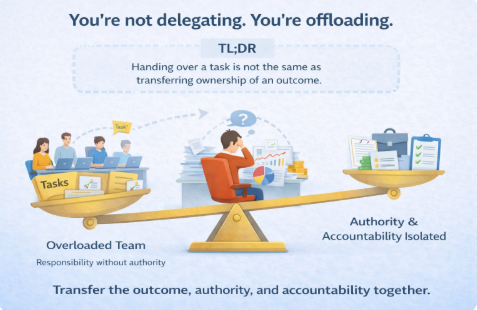
TL;DR
- Handing someone a task is not the same as giving them ownership of an outcome.
- Most Growing Business founders stay the bottleneck even after they delegate because they transfer work without transferring authority or accountability.
- Understanding why delegation fails growing companies starts with recognizing that task handoffs and ownership transfers are not the same thing.
- Real delegation requires three things to move together: the outcome, the authority to act, and the accountability for results.
- If your team cannot make a decision without you in the room, delegation has not happened.
Leadership and team management breaks when accountability exists without authority and ownership. Managers manage tasks. Decisions bottleneck. The CEO stays in the middle. If you run a Growing Business and feel like you are the only one who can close the hard deals, resolve the client escalations, or make the call when two priorities conflict, this post is about that. Specifically, it is about why delegation fails growing companies and how to fix the structural problem underneath it.
The transition from founder heroics to repeatable operations is one of the most consequential shifts a CEO makes. You have proven the model. You have a team. You have told people what their jobs are. And yet the business still runs on your judgment, your relationships, and your willingness to step in when things get complicated. You have handed off tasks. You have not handed off ownership. That is exactly why delegation fails growing companies at this stage more than any other.
This distinction matters more than most founders realize until the cost shows up in missed revenue, slow decisions, or a leadership team that never fully develops because it is never fully tested. Gallup research found that only one in four employer entrepreneurs have high levels of Delegator talent, and those who do generate measurably stronger team growth and business performance. The gap between founders who scale and founders who stall is not strategy. It is whether the people around them own outcomes or just execute instructions.
The difference between a task and an outcome
A task has a finish line. An outcome has a standard. When you hand someone a task, you tell them what to do. When you hand someone an outcome, you tell them what success looks like and then get out of the way. The problem is that most founders, consciously or not, delegate tasks. They assign work in the form of actions rather than in the form of results. The person on the receiving end executes the action. Then they come back to you because the next action requires a judgment call you have not transferred.
This is task dumping. It looks like delegation. It has the right vocabulary. Someone is responsible for it. But the moment a variable enters the picture that was not in the original instruction, the decision flows back to you. Your calendar fills with it. Your Slack fills with it. Your weekends fill with it.
The other signal is emotional: you find yourself frustrated that your team is not taking initiative. They are not taking initiative because initiative requires authority, and you have not granted authority. You have granted execution.
Why founders default to task dumping
The instinct comes from a legitimate place. You built this company by knowing every detail of how it works. You have strong opinions on how decisions should be made because, at some point, you made all of them. Task dumping feels like delegation because something is leaving your hands. The feedback loop tells you it is working because the task gets done.
What the feedback loop does not tell you is that every task completion is also a missed opportunity for your team to develop judgment. Every time you describe the steps instead of the standard, you train your team to wait for steps. Over time, you build a group of capable executors and no leaders. The company scales headcount without scaling capability, and why delegation fails growing companies becomes the central constraint on your growth ceiling.
The three elements real delegation requires
Real delegation is not an assignment. It is a transfer. For that transfer to be complete, three things must move together.
- The first is the outcome. The person needs to know what success looks like in measurable terms. Revenue retained. Cycle time reduced. Decision made. Not a list of steps, but a result with a standard attached to it.
- The second is authority. The person needs the right to act without asking you first. This means access to resources, access to information, and explicit permission to make the judgment calls the role requires. Authority without this is theater. You can call someone an owner of something while structurally requiring them to check with you before they do anything material. That is not ownership. That is supervised execution with a title change.
- The third is accountability. The person needs to know they will answer for the result. This is the one founders most frequently skip because it feels harsh, and because it requires the CEO to hold the line when the result is not what was expected. Accountability without authority is unfair. But authority without accountability is also broken. Both must be present for delegation to function.
How to know if your team owns it
Diagnosing why delegation fails growing companies requires you to look past titles and look at decision flow. If the outcome is truly delegated, your team member can answer three questions without calling you: what does success look like, what am I authorized to do to get there, and what happens if I do not deliver it?
If any of those three questions sends them back to you, the delegation is incomplete. It is not a performance problem. It is a structural problem. The handoff was partial, and partial handoffs produce partial ownership.
A second test: observe what happens when something goes sideways. In a task-dumping environment, the first move is to find you. In a real delegation environment, the first move is to solve the problem within the authority granted and report back. If your team’s instinct in a crisis is to escalate before acting, you have not transferred ownership. You have transferred workload.
The Ownership Transfer Protocol
The framework that fixes why delegation fails growing companies is not complicated, but it is deliberate. The Ownership Transfer Protocol is a structured three-part handoff that ensures outcome, authority, and accountability move together.
Start with the outcome statement. Write it down. One sentence that defines what success looks like in specific, measurable terms. If you cannot write it in one sentence, you do not have enough clarity to delegate it. Get clarity first.
Then define the authority boundary. Be explicit about what the person can decide without you and what requires your input. The goal is to make the boundary as wide as possible while preserving the decisions that genuinely require CEO-level judgment. Most decisions do not require CEO-level judgment. You will be surprised by how few actually do when you force yourself to draw the line.
Finally, establish the accountability agreement. Agree on a cadence for reviewing results, not activity. What will you look at together? What constitutes good performance? What constitutes a problem that requires intervention? Write that down too. The accountability agreement is what makes the transfer real. Without it, the delegated outcome floats in an undefined space where no one is truly responsible.
Run this protocol for every significant handoff. It takes fifteen minutes the first time. It saves hundreds of hours of re-entry over the following months.
CEO-actionable decisions
Why delegation fails growing companies is a structural problem with a structural fix. Three decisions you can make this week.
- First, identify one outcome you are currently managing that should belong to someone on your team. Apply the Ownership Transfer Protocol to it. Transfer the outcome, the authority, and the accountability in a single conversation.
- Second, audit the last ten decisions that came to you in the past two weeks. For each one, ask whether it required your judgment or whether it came to you because the authority to decide had not been clearly granted elsewhere. Redesign the authority structure so those decisions do not have to reach you.
- Third, stop describing steps in your delegation conversations. Describe the standard. Ask your team member to come back to you with the plan, not the other way around. The moment you hand someone a plan, you have made them a contractor. The moment they hand you a plan, you have made them an owner.
The Founder Flywheel engagement is built specifically for the CEO who has a team but is still the answer to every hard question. We redesign decision flow, clarify authority structures, and build the leadership layer that lets the business run without you in the center of it.
The question worth sitting with is this: if you were out of contact for thirty days, which decisions would your team make confidently and which ones would stack up waiting for you? The answer to that question is a more accurate picture of your delegation than anything on your org chart.