
TL;DR
- Hiring before you fix your structure does not solve the problem. It funds it.
- A talented person sitting in a broken seat will underperform, disengage, and leave.
- The role exists on paper. The ownership does not exist in practice. That gap compounds with every new hire.
- Org design is not an HR exercise. It is a decision about who owns what before anyone signs an offer letter.
- Until you answer the ownership question, org design before hiring more people is the only move that protects your growth.
- Hiring and people decisions break when headcount is used to avoid the leadership and structure decisions that should have been made first.
You add a role because something is not getting done. The answer most founders reach for is another hire. The answer the business needs is org design before hiring more people.
The problem is not capacity. The problem is that no one owns the outcome, decision rights are unclear, and the accountability structure was never built for the volume you are now running.
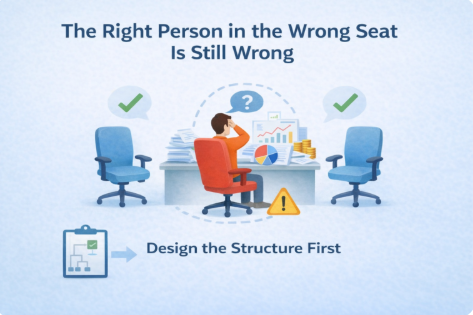
The new hire walks in, looks for their seat, and finds it is a shape-shifting job description attached to expectations nobody agreed on. Six months later, you are frustrated. They are confused. The problem that triggered the hire is still alive. Now it has an additional salary attached to it.
This is not a hiring problem. It is a structure problem dressed up as a hiring problem. It is one of the most common ways growing businesses stall.
Why Org Design Before Hiring More People Is Not Optional
The moment a company moves from founder heroics to something resembling a team, the rules change. Decisions that used to live in one person’s head now need to be distributed. Work that used to flow through relationships now needs to flow through roles.
Most founders recognize this in theory. Very few act on it before they open the next req.
The pressure to hire feels urgent. The work to design the org before you hire feels abstract. So founders skip it. They post the job, fill the seat, and wonder why the results do not improve.
Every hire into an undefined seat is a structural tax. You pay it in salary, then pay it again in replacement cost when the person exits a role that was never designed for them to succeed in.
What You Are Buying When You Hire
Every hire is a bet. You are betting that the role is real, that ownership is clear, and that the person can operate with enough autonomy to produce outcomes without constant intervention from you.
When all three conditions are true, the hire works. When any one of them is false, you have bought yourself a problem with a salary attached.
Most founders focus on the person. They run interviews. They check references. They agonize over culture fit. They do almost none of this analysis on the role itself. They do not ask whether the role has a defined outcome. They do not ask who this person owns decisions with and who they defer to. They do not ask what success looks like at 90 days in terms of outputs, not activities.
When the hire underperforms, the instinct is to blame the person. The actual cause is usually the seat.
Every founder who skips org design before hiring more people pays for that decision twice: once in salary, once in replacement cost.
The Structure Gap No Job Description Fixes
A job description tells you what someone will do. It does not tell you who owns the outcome when the work touches two departments. It does not tell you where this person sits in the decision flow. It does not tell you what they can move without approval and what requires escalation.
That gap is structural. You cannot write your way out of it with a better job description. You have to resolve it before the person starts.
Growing businesses accumulate structural gaps the same way they accumulate operational debt. You move fast. You figure it out as you go. The team is small enough that relationships compensate for the absence of structure. Then the team grows, and the relationships stop compensating.
Decisions start bouncing. Work falls between roles. The CEO re-enters conversations they thought were delegated. The fix always feels like another hire. It almost never is.
The fix is org design before hiring more people. And it starts before the req gets posted.
How to Design Before You Post the Req
Start with one question: what outcome does this role own?
Not what tasks this person will perform. What result are they accountable for, measured how, reviewed when, and tied to which business objective. If you cannot answer that in two sentences, you are not ready to hire. You are ready to do design work.
After the outcome, answer the authority question. What can this person decide alone? What requires sign-off? Who do they coordinate with, and on what?
Coordination without authority is a full-time job that produces nothing. Someone is hired to own a function, but every decision above a trivial threshold comes back to the founder. The person spends their time preparing recommendations instead of making calls. They are not empowered. They are a high-paid analyst with a senior title.
Then answer the integration question. Where does this role hand off to another role, and what does a clean handoff look like? Unclear handoffs are where accountability goes to die. Every handoff point in your org is a potential breakdown. Design the handoffs before you design the hire.
The Ownership Test: Run This Before Every Req
Before you open any role, run four questions. This is the difference between a hire that accelerates the business and one that adds weight to it.
- What is the single outcome this role owns, and how do you measure it? If the answer involves more than one primary metric or more than one function, the role is too broad or the structure underneath it is undefined.
- What decisions can this person make without approval, and what requires escalation? If the escalation list is longer than the autonomy list, you have not delegated the role. You have delegated the work.
- Where does this role create dependency on the founder? Dependency by design is a transition plan. Dependency by default is a trap you are about to pay someone to reinforce.
- If this person left in 90 days, would the outcome they own be documentable, transferable, and re-hireable? If no, the role is not a role yet. It is a person-shaped workaround.
Run this test on every open req before you post it. Run it on your existing team while you are at it. You will find seats that are misaligned, outcomes owned by nobody, and decision rights that exist in practice but were never made explicit.
That is your org design before hiring work. Do it before the next offer letter.
What Changes When Structure Comes First
When you design before you hire, three things happen.
Onboarding accelerates because the new person understands what they own from day one. Performance is easier to evaluate because success was defined in advance, not reverse-engineered after a frustrating quarter. And the founder exits the role faster because the handoffs were designed, not improvised.
Every hire you make into a well-designed seat builds organizational muscle. The person knows their lane, operates with confidence, and produces outcomes without pulling you back in.
Every hire you make into an undefined seat does the opposite. It adds bodies to a structure that cannot absorb them cleanly. The business gets heavier. Execution slows. You end up managing people instead of building the company.
Org design before hiring more people is not a slowdown. It is the condition under which hiring actually works.
The founders who resist it usually believe speed is the advantage. Speed is an advantage when you are moving in the right direction. When your structure is broken, speed compounds the damage.
The Next Time You Feel the Pull to Post a Req
Stop for one hour. Run the Ownership Test on the role you are about to fill.
If you cannot pass it, you are not hiring too slowly. You are catching the mistake before it costs you.
At Oper Hand, we install the revenue and operations systems that let decisions move down and execution move up. That starts with knowing what each seat owns before you fill it.
If your structure is the problem, adding headcount makes it worse.