
TL;DR
- Your team is not underperforming. They are performing exactly to the standard your behavior sets.
- Culture is not built in offsites or value statements. It is built in every decision you make in public.
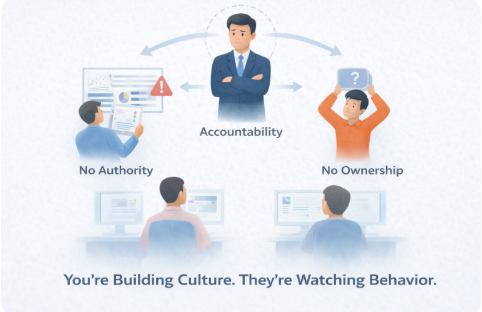
- Leadership and team management breaks when accountability exists without authority and ownership, and the CEO stays in the middle.
- The gap between what you say the culture is and what your team experiences it to be is the most expensive gap in your business.
- You cannot redesign the culture without changing the behavior that created it.
Understanding how leaders shape company culture starts with a single breakdown: leadership and team management fails when accountability exists without authority and ownership. Managers manage tasks. Decisions bottleneck at the top. The CEO stays in the middle of everything, and the team learns to wait. Every CEO who wants to understand how leaders shape company culture needs to start there, at the point where the behavior and the expectation split.
Culture is not a values poster. It is not a quarterly all-hands. It is the pattern your team observes when you make decisions under pressure, when you tolerate underperformance, when you step in and solve a problem your manager should have owned. Every time you do that, you teach your team something. The lesson is rarely the one you intended.
Research confirms how leaders shape company culture drives hard business outcomes. The SHRM State of Global Workplace Culture report found that employees in positive organizational cultures are nearly four times more likely to stay with their employer. That retention advantage does not come from perks or vision statements. It comes from consistent, observable leadership behavior that matches what the organization says it expects. When that alignment breaks down, the cost shows up in turnover, decision latency, and an execution bench that cannot hold weight.
What You Do Is the Policy
In a growing business, the transition from founder heroics to repeatable execution is the defining challenge. Delegation begins. Systems start to form. But the founder’s behavior often does not change, and that disconnect becomes the operating standard the entire organization builds around.
When you jump into a deal to save it, you teach your sales team that rescue is always available. When you approve decisions your managers should own, you teach them that ownership is performative. When you respond to every urgent message at 9pm, you set the pace for everyone below you. These are not cultural accidents. They are cultural policies, set by you, enforced by repetition.
This is exactly how leaders shape company culture at the growing business stage, not through intent, but through the daily decisions that get observed, repeated, and normalized across every level of the organization. The question is not whether it is happening. The question is whether you are directing it.
The Mirror Test
The Mirror Test is a diagnostic built for CEOs at growing businesses. It surfaces the gap between the culture you say you are building and the culture your behavior is actually installing. Run it against four signals.
First, look at where decisions are landing. If your managers bring you problems instead of solutions, and if those conversations end with you making the call, your behavior has trained them to escalate. Ownership does not transfer through an org chart. It transfers through consistent, repeated experience of being trusted to decide and being held to the result.
Second, look at what you tolerate. Every behavior you allow without consequence becomes a cultural norm. If a manager misses a commitment and you absorb the work rather than address it directly, you have communicated that accountability is optional at that level. Your team does not read your intentions. They read your responses.
Third, look at how you operate under pressure. End-of-quarter heroics, last-minute rescues, and founder-led deals are not signs of a high-performing culture. They are signs of a culture that has learned to wait for the founder. If your best results consistently require your personal intervention, the system is not working.
Fourth, look at the gap between your stated expectations and your daily example. You cannot demand accountability from people you do not hold accountable. You cannot expect calm, deliberate decision-making from a team that watches you operate reactively. The Mirror Test does not lie. It simply shows you what the team has been watching.
Where Growing Businesses Break
At the growing business stage, this failure mode is particularly dangerous because the business looks like it is working from the outside. Revenue is moving. The team is larger. The founder is busy. But underneath, the organization is running on personality, not systems. Execution depends on who calls who. Priorities shift when the founder walks in the room. Managers hedge because they have learned that authority is temporary and can be overridden without notice.
The result is a business that gets heavier every day. More decisions travel up than down. More problems surface at the executive level that should have been resolved two levels below. The founder’s calendar fills with issues that managers should own, and the company’s ability to scale stalls. This is not a people problem. It is a behavior problem, and it belongs to the CEO.
Knowing how leaders shape company culture means accepting that the friction you are experiencing in your organization is a direct output of the patterns you have set. Managers who hedge learned to hedge somewhere. Teams that do not take ownership were never given real ownership. Execution that slows as volume increases is the predictable result of a culture where the founder is the final node in every critical path.
The Behavior Inventory
Three behaviors to audit, change, or install this week.
Stop rescuing decisions. When a manager brings you a problem, redirect it. Ask what they recommend. Ask what they need to make the call. Then let them make it. Do this consistently for thirty days and watch the escalation rate drop. Your job is to build leaders who can hold decisions, not to be the person who always holds them.
Start naming the behavior, not just the outcome. When a commitment slips, do not absorb it. Name it. Sit with the discomfort of a direct conversation. Culture does not change through strategy documents. It changes through the specific, repeated experience of being held to a standard. That experience starts with you having the conversation.
Install a decision framework your team can use without you. Not a policy manual. A simple, shared understanding of what decisions each level owns and what threshold requires escalation. When that framework exists and you respect it, your managers start to trust that ownership is real. When you override it, they learn it was never real to begin with.
This is the operational truth of how leaders shape company culture inside a growing business: the framework matters, but your behavior inside the framework matters more. Systems do not hold without the leader modeling what it looks like to trust them.
Oper Hand’s Efficiency Enhancer is built for this exact constraint. It removes operational drag by clarifying roles, fixing hand-offs, and reducing decision latency across the organization. The drag you are experiencing is not a symptom of growth. It is a symptom of a leadership behavior pattern that has become embedded in how the business runs. Removing it requires both structural changes and a deliberate shift in how you show up as the leader. Headquartered in Bellevue, WA, with an office in Boulder, CO, we install the revenue and operations systems that generate revenue, not burn it. If you are ready to optimize your sales process and drive real growth, let’s talk.
Culture does not drift. It gets built, one observed behavior at a time. The evidence of how leaders shape company culture is not in your values deck. It is in what your team has been watching. The real question is whether you are going to look at what they have been learning.