TL;DR
- Every tool you added was supposed to make the business faster. Most of them didn’t.
- At scale, too many ops tools slowing growth creates the exact operational drag the stack was meant to eliminate.
- The Compound Stack Framework gives you a three-filter test to cut what clutters and keep what compounds.
- If your team spends more time managing tools than using them, your stack is running your business, you aren’t.
- Tighter integration beats bigger toolsets. The companies winning on execution run leaner, not larger.
Too many ops tools slowing growth is the version of this problem no one wants to name, because every tool in the stack was purchased with good intentions and approved by someone in the room. Operations and Efficiency breaks when decisions do not land once. At scale, the symptom shows up as a stack that keeps growing while execution keeps slowing, more tools, more logins, more coordination overhead, and a team that spends its energy managing infrastructure instead of moving the business forward.
This is not a fringe issue. A 2024 survey of 2,000 IT decision-makers by Nintex found that workflow delays rank among the top operational challenges tied directly to software sprawl, alongside security risks and increased manual data entry. Scaling companies feel this pressure acutely because too many ops tools slowing growth compounds at exactly the moment the business needs to accelerate. Every new tool added at volume creates integration requirements, training burdens, data silos, and handoff points where decisions stall. The business does not slow down because people stop working hard. It slows down because the architecture underneath them makes hard work expensive.
The Moment Your Stack Stopped Compounding
There is a specific inflection point in every scaling company where the tooling relationship inverts. In the early stages, each new tool genuinely extends capability. A CRM replaces a spreadsheet. A project management platform replaces email threads. An analytics dashboard replaces gut feel. Each addition produces a measurable return. Then the company scales, headcount grows, teams specialize, and the next tool gets added not to extend capability but to solve a coordination problem created by the previous tool. That is the moment the stack stops compounding and starts cluttering.
You can identify this inflection point by the conversations happening in your leadership meetings. When the discussion shifts from “what do we need to build” to “how do we get the tools to talk to each other,” the stack has crossed the line. The infrastructure that was supposed to accelerate decisions is now generating the decisions that slow everything else down. Recognize this pattern early, because too many ops tools slowing growth does not announce itself with a single event, it arrives as slightly longer cycle times, slightly more re-work, and slightly more meetings to align on information that should already be visible.
What Tool Clutter Actually Costs You
Too many ops tools slowing growth registers first as a feeling before it shows up in a number, and that delay is exactly why scaling CEOs underreact to it. The license fees compound. Vendor contracts renew automatically. Training cycles eat onboarding time. But the economic cost that matters most at scale is not on the P&L. It is in execution latency, the gap between when a decision needs to be made and when the information required to make it is actually available, trusted, and in the right hands.
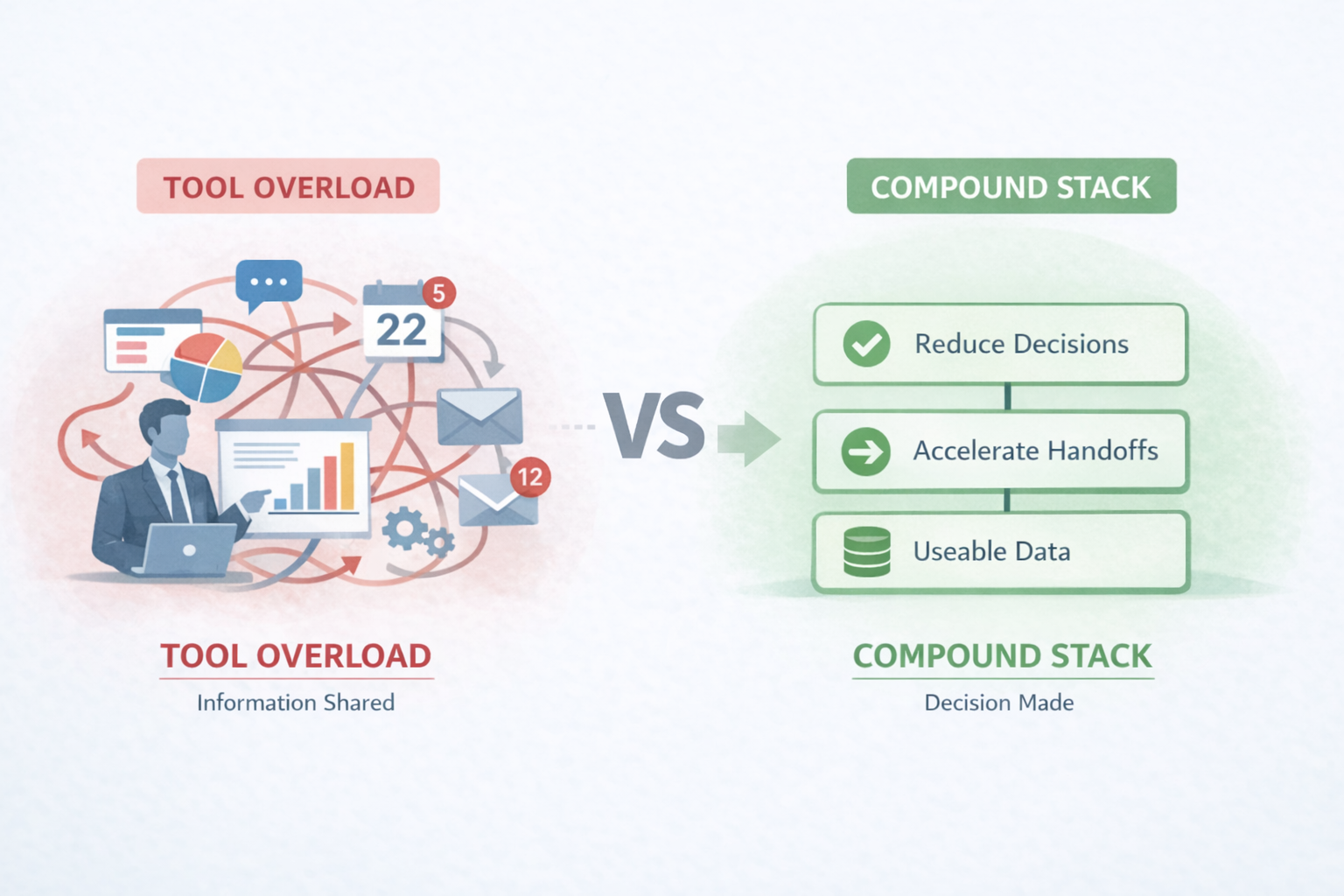
Tool clutter generates three specific execution taxes. The first is data fragmentation, where the same metric lives in three systems and no one agrees on which number is right. The second is handoff failure, where a process moves from one tool to another and accountability does not travel with it. The third is cognitive load on your operators, who carry the mental map of how everything connects because the stack does not carry it for them. Each of these taxes is invisible on a dashboard. All of them are visible in how long it takes your business to act.
The Compound Stack Framework
The Compound Stack Framework is a three-filter test you apply to every tool in your ops infrastructure. It does not replace a full audit. It gives you a forcing function to make defensible keep-or-cut decisions before the audit turns into a six-month project.
Filter one: Does this tool reduce decisions? A compounding tool eliminates a category of judgment calls your team previously had to make manually. A cluttering tool creates judgment calls about itself, which field to use, which status to set, which integration to trust. If your team is making decisions about the tool instead of through the tool, it fails this filter.
Filter two: Does this tool accelerate handoffs? Execution speed at scale is determined almost entirely by how cleanly work moves between people and functions. A compounding tool makes the next person’s job start before the current person’s job ends. A cluttering tool requires a conversation, a Slack message, or a meeting to complete the transfer. If accountability does not move automatically when work moves, the tool fails this filter.
Filter three: Does this tool create data your team actually uses? Not data that exists. Not data that gets pulled for quarterly reviews. Data that drives weekly decisions by the people closest to the work. If the output of a tool is a report that no one reads until something goes wrong, it is not compounding. It is archiving. Archive tools are not operations tools. They are risk management theater.
How to Audit What Stays and What Goes
Run the Compound Stack Framework against your current toolset in a single working session. Pull your active subscriptions, map each tool to the three filters, and score each one. Tools that pass all three filters stay. Tools that fail one filter get a 30-day review period with a defined owner and a decision deadline. Tools that fail two or three filters get cut in the next billing cycle.
The resistance you encounter in this process is information. The tools your team fights hardest to keep are the ones that have become identity rather than infrastructure. A sales leader who insists on a reporting tool that only they can interpret is not defending execution. They are defending position. Surface these conversations directly. The audit is not a cost-cutting exercise. It is a diagnostic that reveals where accountability has fragmented and where information has become a source of power rather than a shared operational asset.
The Decisions Only You Can Make
Your team will not rationalize the stack on your behalf. They will protect the tools they know, even when those tools are costing the business momentum it cannot afford at this stage of growth. The CEO is the only person with the authority and the vantage point to make the structural call that the stack needs to contract before it can compound again. Too many ops tools slowing growth is a leadership problem before it is a systems problem, and deferring it is a decision with a compounding cost.
That call requires you to accept a short-term operational disruption in exchange for long-term execution clarity. Teams will need to rebuild habits. Integrations will need to be rewritten. Some reporting will temporarily degrade. The businesses that stall at scale are the ones whose CEOs defer this decision because the short-term disruption feels more certain than the long-term gain. It is not. The gain is compounding. The deferral is the liability.
Headquartered in Bellevue, WA, with an office in Boulder, CO, we install the revenue and operations systems that generate revenue, not burn it. If you are ready to optimize your sales process and drive real growth, let’s talk. At Oper Hand, the Efficiency Enhancer engagement starts with a single question: which parts of your stack reduce decisions, and which parts create them? The answer tells you everything about where your execution is leaking and what it will take to seal it.
When your business gets heavier every quarter despite adding more tools and more headcount, the stack is not the solution. It is the symptom. The companies that scale with speed and margin intact do not have more infrastructure than their competitors. They have cleaner infrastructure. They made the hard call earlier. They cut what cluttered. They kept what compounded. They stopped letting the tools run the business. Stop letting too many ops tools slowing growth be the constraint that compounds while you wait for a better quarter to fix it.