
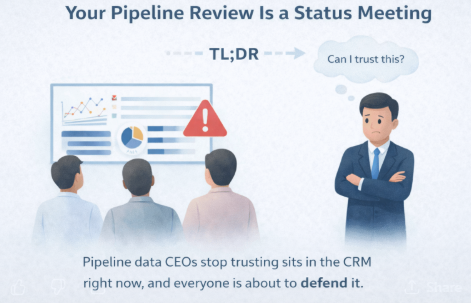
TL;DR
- Leads and pipeline break when there is no full-funnel rigor or truth in the numbers, and most scaling companies have neither.
- Your pipeline review is a reporting exercise. It does not tell you whether those deals are real.
- Activity in your CRM is not evidence of buyer intent. It is evidence that your reps know how to fill fields.
- The Pipeline Truth Standard is a three-filter test that reclassifies phantom deals before they become missed quarters.
- If you are waiting for the revenue miss to audit the pipeline, you are already too late.
The pipeline data CEOs stop trusting is sitting in your CRM right now, and everyone in your next review is about to defend it.
The readout has data. No one trusts it. Your reps defend it anyway.
Quarter ends. You’re short. Everyone in the room has a reason. None of them is wrong. That’s the problem.
A shaky pipeline doesn’t announce itself. It survives every review until there is a revenue miss.
That is not a quarter-end problem. That is a pipeline problem you were looking at for ninety days and misread every single week.
The issue is structural. At scale, the CEO is further from the buyer than at any prior stage of the company. More reps, more deals, more pipeline stages, more CRM fields. The data volume increased, and the signal quality dropped. What replaced your direct judgment was a review process that nobody designed to produce truth. It was designed to produce status updates. Those are different outputs, and the gap between them is where your forecast breaks.
Research from Forrester found that organizations with structured forecasting processes achieve fifteen percent higher overall forecast accuracy than peers who rely on ad hoc reviews. The companies without that structure are not failing because they lack data. They are failing because the pipeline data CEOs stop trusting is data that their review process was never built to challenge.
What Pipeline Theater Looks Like
Pipeline theater is not fraud. Your reps are not lying to you. They are reporting their version and what they report reflects their optimism about where each deal stands. That optimism is not malicious. It is human. Reps want to believe their deals will close. Managers want to believe their teams will hit the number. Because nobody has built a process that forces objective verification, that belief travels up the chain until it becomes your forecast.
The symptoms are recognizable across all scaling companies. Deals sit in the same stage for six weeks with no documented buyer movement. Close dates slip one quarter, then another, with no change to probability. Pipeline coverage ratios look healthy on paper while actual deal progression tells a completely different story. The pipeline data CEOs stop trusting looks exactly like this: activity in the CRM dressed up as forward momentum, reported in a weekly meeting as if it means something.
It does not mean anything. Activity is not momentum. And at scale, a pipeline full of unverified activity does not just distort your forecast. It distorts every resourcing decision, every capacity plan, and every conversation you have with your board.
The Numbers Your Team Trusts That You Should Not
Understanding why the pipeline data CEOs stop trusting accumulates in the first place requires looking at three specific numbers that get treated as evidence of pipeline health when they are not.
- The first is the total pipeline value. A large pipeline number is a starting point for analysis, not a conclusion. It tells you how much your reps believe could close. It tells you nothing about how many of those deals have a verified buyer engaged and actively moving toward a decision.
- The second is stage progression. Moving a deal from Stage 2 to Stage 3 in your CRM means a rep decided to move it. It is a unilateral act. Unless your stage definitions require documented buyer actions, a confirmed meeting with a decision-maker, a written next step accepted by the buyer, a verbal commitment to a timeline, stage progression is an internal administrative event with no external validity.
- The third is rep confidence. In a weekly pipeline review, when a rep says a deal is on track, that statement is almost always based on their last conversation with their primary contact. It is not based on a verified read of the full buying committee, the budget status, or the competitive position. Confidence is not a forecast input. It is a mood.
The Pipeline Truth Standard
The pipeline data CEOs stop trusting does not become trustworthy by adding more CRM fields or running more frequent reviews. It becomes trustworthy when you introduce a standard that separates verified deals from placeholders. The Pipeline Truth Standard is that standard. It is a three-filter test applied to every deal in your pipeline. Any deal that fails one filter gets reclassified immediately. Not coached. Not defended. Reclassified.
- Filter one: verified buyer engagement. In the last fourteen days, has a real buyer, someone with authority or direct influence over the decision, taken a documented action that signals forward movement? A response to a proposal, a confirmed next meeting, a request for additional information, a legal or procurement review initiated. Passive activity from your side does not count. The buyer has to move.
- Filter two: a stated next step with a date the buyer has accepted. Not a next step your rep plans to take. A next step the buyer has agreed to. There is a meaningful difference. If your rep is waiting on the buyer, the deal is stalled. A stalled deal with a close date is not a pipeline asset. It is a wish.
- Filter three: an economic decision-maker on record. Someone with budget authority has been on at least one call and has not disengaged. This is not about job title. It is about whether the person who will sign the check has any active awareness that a decision is being built toward. If the deal has never touched that person, the probability assigned to it is fictional.
Run this test in your next pipeline review. Reclassify every deal that fails any filter as a development opportunity, not a forecast-ready deal. Your pipeline will shrink. Your forecast will be smaller and more accurate. That is the point. A smaller, honest pipeline gives you real options: you know exactly where you need to generate new opportunities, and you can make those decisions in time to act.
What a Real Pipeline Review Forces
The moment you stop accepting the pipeline data CEOs stop trusting and start requiring verified data instead, the review meeting changes entirely. It stops being a reporting session and becomes a verification session. The CEO or revenue leader enters with the Pipeline Truth Standard and applies it deal by deal. Reps do not present their pipeline. They defend it against objective criteria. The question is never “how do you feel about this one?” The question is “what did the buyer do in the last two weeks that confirms this deal is real?”
This changes the preparation required. Reps who know they will be asked for documented buyer actions start creating documented buyer actions. The review process shapes selling behavior directly. When the standard is optimism, optimism is what you get. When the standard is evidence, evidence is what gets produced.
The review also exposes exactly where your pipeline breaks. If the same stage is where every deal stalls, you have a stage problem, either the criteria are wrong or the skills to advance deals through that stage are missing. If deals fail Filter Three consistently, you have a coverage problem: your reps are selling to the wrong people and never reaching economic buyers. These are structural problems that a status meeting will never surface, because a status meeting is not designed to find them.
The CEO’s Role in Enforcing Rigor Without Managing Reps
Your job is not to inspect every deal. Your job is to set and hold the standard. That means two things.
- First, the Pipeline Truth Standard has to be non-negotiable. The moment you accept a deal defense that does not meet the filter criteria, because the rep is confident, because it is a marquee account, because the number looks better if you leave it in, you have signaled that the standard is optional. Optional standards are not standards. They are suggestions. Suggestions produce theater.
- Second, accountability for pipeline quality belongs to your revenue leader, not to you. You are not the pipeline auditor. You are the person who decides whether your revenue leader has built a process that produces honest data. If your revenue leader cannot tell you at any given moment which deals are forecast-ready and which are in development, you have a leadership gap, not a pipeline gap. Fix the right problem.
The Growth Catalyst engagement starts with a diagnostic of exactly this problem, where in your pipeline the signal is real and where it is theater, and builds the system that makes the difference visible before it becomes a miss.
The pipeline data CEOs stop trusting does not fix itself. It compounds. Every week you run a status meeting instead of a verification session, the gap between what your pipeline says and what your pipeline is gets wider. Enforce the Pipeline Truth Standard, reclassify what is not real, and build from an honest position. The pipeline shrinks. The forecast holds. And every decision you make from that point forward is grounded in something worth trusting.