
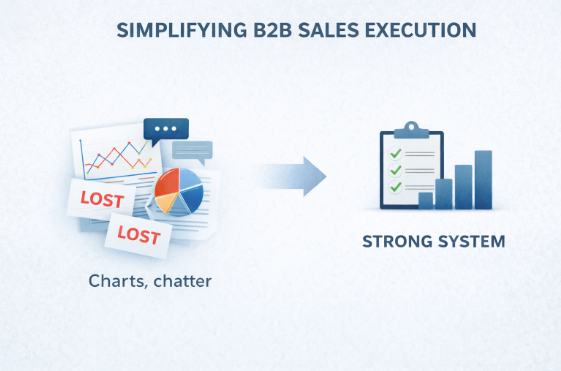
Simplifying B2B sales execution starts with an uncomfortable truth. Sales did not become complicated because your market matured. It became complex because leadership stopped enforcing clear judgment and replaced it with a structure that looks impressive but isn’t a system.
TL;DR
- Sales complexity is a leadership response to uncertainty, not a growth requirement.
- Adding stages and tools did not fix unclear deal ownership.
- Growing businesses stall when sales execution becomes performative.
- Simplifying B2B sales execution restores revenue predictability by forcing decisions back into the system.
Deals advance on paper but never move in reality. Stages change without real buyer commitments behind them. Forecasts shift week to week with no single moment that explains why. Reps stay busy because activity is easy to produce. Managers stay occupied because reporting fills the time. You stay uneasy because none of it adds up to confidence.
This is not normal growth friction. It is not the cost of scaling. It is the signal of a system that has been built to avoid hard calls. This is the pattern that emerges when founder-led sales stops working, leadership fills the gap instead of fixing the system
Instead of forcing decisions, the process absorbs uncertainty. Instead of surfacing risk early, it allows deals to drift forward until they become uncomfortable to question. Pipeline reviews turn into explanations of why something might still close instead of decisions about whether it should exist at all.
When that happens, the review itself becomes the work. Judgment gets replaced by updates. Accountability fades because no one wants to be the one to kill a deal that looks active on a dashboard. The result is motion without progress and visibility without control.
A healthy pipeline review reduces complexity. It narrows focus, forces choices, and restores trust in what the numbers actually represent. When reviews feel heavier over time, it is usually because the system is protecting people from decisions rather than helping leaders make them.
Why This Matters Now
Growing businesses cross a line where volume exposes weakness. Founders no longer touch every deal. Conversations get summarized instead of heard. Judgment gets diluted across tools and stages.
At the same time, buying itself has become harder. Industry research reported by AMPLYFI shows that the average number of stakeholders involved in B2B purchase decisions grew from 3.3 in 2023 to 4.0 in 2024, reaching 4.14 in 2025. More voices enter the room. More delays become possible. More ambiguity creeps into deals that are not tightly owned.
This is the moment where simplifying B2B sales execution becomes necessary, not optional.
Most leaders respond by adding process. They believe structure will protect them from uncertainty. What it actually does is hide it.
Complexity delays accountability. Delay kills momentum.
Where Sales Complexity Really Comes From
Sales systems rarely become bloated by accident. They become bloated when leadership loses confidence in what is actually happening inside deals.
Stages get added because qualification feels weak. Tools get layered in because deals slip without a clear explanation. Reports multiply because forecasts miss and no one wants to be exposed. Each change looks reasonable in isolation. None of them address the root issue.
The real problem is structural. There is no shared definition of what a real opportunity is. There is no clear owner of the next decision in a deal. There is no consequence when momentum stalls. Without those anchors, leadership tries to manage uncertainty through process.
Instead of confronting weak execution, the system grows around it. Sales execution starts to look busy without being decisive. Deals move forward on paper while nothing actually advances.
The Hidden Cost of Overbuilt Sales Systems
Every added layer introduces drag.
Sales cycles stretch because stages describe activity rather than commitment. Reps learn how to stay compliant instead of how to close. Managers spend more time reviewing dashboards than making calls that force clarity. Leaders get pulled back into late-stage deals they believed the system should handle on its own.
The system becomes heavier. Revenue does not become more predictable. Over time, complexity turns into cover. Teams blame process, tools, or data quality instead of facing the absence of ownership and decision pressure.
Buyers feel this immediately. When your team is unclear on who owns the next decision, buyers hesitate. When no stage forces a real commitment, deals drift. What looks like sales complexity from the inside feels like uncertainty from the outside.
Simplifying B2B Sales Execution Starts With Truth
Simplifying B2B sales execution is not about moving faster or cutting stages for the sake of simplicity. It is about restoring cause-and-effect to the sales motion.
A deal should only exist when a buyer has made a concrete commitment to advance. Every stage should represent a decision, not an activity. Ownership of the next move should be explicit, and stalls should trigger action rather than tolerance.
When those conditions are in place, systems shrink naturally. Fewer tools are needed. Fewer reports matter. Forecasts improve not because models get better, but because reality gets clearer.
Simplifying B2B sales execution is ultimately a leadership choice. You can manage uncertainty with more process, or you can remove it by forcing clarity. Only one of those scales.
What Strong Operators Simplify First
Strong operators do not ask how to optimize sales tools. They ask what clarity is missing.
They simplify four things immediately.
- They define what a qualified opportunity means.
- They assign explicit ownership of the next decision in every deal.
- They narrow weekly reviews to signals that drive action.
- They expect communications and meetings to verify that progress is really taking place.
This is not elegance. It is discipline.
A Sales Discipline That Actually Scales
Here is the mistake most leaders make. They think simplification lowers standards.
It does the opposite.
Simplifying B2B sales execution means fewer stages with harder exits.
- One definition of pipeline health that everyone uses.
- Manager judgment overrides automation when reality disagrees.
- Cadence forces decisions, not explanations.
This system scales because it removes ambiguity. Ambiguity is what breaks under volume.
Leadership Owns Sales Execution
Sales issues at this stage are leadership issues wearing a sales label.
If reps qualify softly, leadership tolerated it.
If forecasts swing wildly, leadership accepted wishful thinking.
If deals stall quietly, leadership avoided confrontation.
The sales system reflects the conversations leadership chose not to have.
That is why simplifying B2B sales execution always starts at the top.
The Founder Check
Ask yourself one question.
If you stripped half your sales process tomorrow, would outcomes collapse or improve?
If that question makes you uncomfortable, that discomfort is the signal.
Sales is not complex.
Avoidance is.
And simplifying B2B sales execution is how growing companies reclaim control before complexity becomes permanent.