
TL;DR
- Leads and pipeline breaks when there is no full-funnel rigor or truth in the numbers, and your best reps pay the price first.
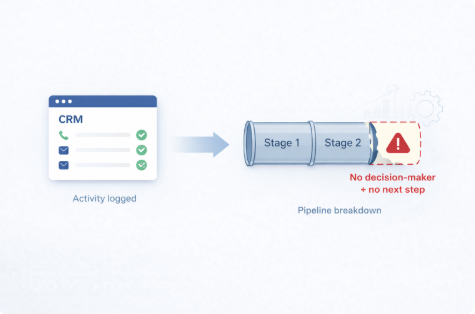
- A CRM full of activity is not a pipeline. It is a record of work that may never convert.
- Good reps operating inside a broken system do not fix the system. They absorb the damage until they leave or get fired.
- The qualification gap is the single most expensive structural failure in a growing business.
- Before you judge rep performance, audit what you built for them to work inside.
Leads and pipeline breaks when there is no full-funnel rigor or truth in the numbers. You hired capable people, pointed them in the right direction, and expected revenue to deliver. Months later, the pipeline looks full, the team looks busy, and the numbers still do not add up. The instinct is to question the hire. The more accurate question is what system those reps are working.
For a growing business in transition, this moment arrives fast. The founder just stepped back from selling. The first outside reps are 60 to 120 days in. Early results feel soft. Before any performance conversation happens, the CEO needs to confront a harder truth: most reps who underperform in their first year are not failing because of talent. They are failing because the pipeline they inherited was never built to produce results. According to analysis of over 150 sales teams using data from more than one million sales calls, this is not a motivation problem it is a systems problem. In 2024, 91% of sales organizations missed quota expectations. The rep is rarely the root cause.
What a Broken Pipeline Actually Looks Like
A broken pipeline does not announce itself. It looks functional on the surface: deals with every stage, activities in every column, and weekly updates that confirm the team is moving. What it hides is worse than what it shows. Stages carry deals that have not progressed in 30, 60, or 90 days. Lead sources are never audited for conversion quality. Entry criteria do not exist, so anything that looks like interest becomes an opportunity. The forecast is built from the rep’s optimism, not from evidence. The CEO reviews a pipeline report and feels reassured, then misses the quarter and cannot explain why.
The structural problem is that activity and progress are not the same thing. A rep can make calls, send follow-ups, log meetings, and still be working inside a system that produces no real pipeline. When leads enter without qualification, when stages have no exit criteria, and when decision-maker access is not confirmed at entry, every deal in the CRM represents effort, not revenue potential. The numbers look like work. They do not represent the truth.
How Good Reps Absorb the Damage
- A capable rep dropped into a broken pipeline does one of two things. They work harder, or they work around it.
- In the first case, they generate more activity to compensate for low conversion: more calls, more emails, more follow-ups on deals that are already dead.
- In the second case, they start cherry-picking: focusing on the handful of deals that feel real and ignoring the rest. In both cases, performance looks inconsistent from the outside. The CEO sees a rep who runs hot and cold. The rep sees a system with no floor.
- The damage compounds because the CEO interprets the inconsistency as a people problem. More coaching gets applied. Higher activity targets get set. The rep works harder inside the same broken structure and produces the same results. Within 90 days, you are questioning whether the hire was the right one. Within six months, you are replacing someone who was capable all along. The hiring cost, the ramp time, and the lost pipeline that never materialized are the real expenses. They just do not show up labeled as a systems failure.
The Qualification Gap Nobody Names
The most expensive structural failure in a growing business is not a bad hire. It is the absence of a repeatable qualification standard: a clear, enforced set of criteria that determines whether a lead belongs in the pipeline at all. The framework that makes this visible is the Pipeline Truth Filter, a three-layer diagnostic that every CEO can apply before the next pipeline review.
- The first layer is lead source integrity. Where is the lead coming from, and what is the historical conversion rate of that source? If you cannot answer that question with data, your pipeline is built on assumptions. Leads that convert at a low rate from a particular channel inflate volume and dilute rep focus.
- The second layer is stage definition clarity. Does each stage represent a verified change in deal status, or does it represent what the rep hopes is happening? If moving a deal from one stage to the next requires no confirmation from the buyer, your stages are fiction.
- The third layer is decision-maker access at entry. If the rep is not confirmed to be in conversation with someone who has authority or influence over the buying decision, the deal should not be in the pipeline at all. It belongs in a prospecting list.
If any one of these layers is missing, your pipeline is producing noise, not signal. Your forecast is a hope dressed in a spreadsheet. And why good salespeople stop performing in your organization has less to do with their capability than with the absence of any of these three conditions.
What Full-Funnel Rigor Actually Requires
Building a real pipeline means the CEO makes decisions that cannot be delegated. You must define entry criteria and enforce them, which means deciding what qualifies a lead to enter the pipeline and holding reps accountable to that standard before a deal gets created in the CRM. You must define stage exit rules, which means specifying what evidence must exist for a deal to advance from one stage to the next. A rep’s feeling that a deal is moving forward is not evidence. A scheduled next step with a named buyer who confirmed it is evidence.
You must also build honest forecast categories. Most growing businesses operate with two forecast states: open and committed. What you need is a third category between them that deals where interest is real but qualification is incomplete. That category is not pipeline. It is a watch list. Separating those two populations from your committed pipeline is what makes the forecast tell the truth. When the forecast tells the truth, you can coach against real data and make real decisions.
CEO-Actionable Decisions
Three decisions to make this week.
- First, audit every deal in the pipeline older than 45 days and require the rep to identify the named decision-maker they have spoken with and the confirmed next step with a date. Any deal that cannot answer both questions moves off the pipeline and into a watch list.
- Second, define entry criteria for any new deal entering the CRM. Require at minimum a confirmed lead source, a verified contact with buying influence, and a problem the rep has heard the prospect articulate in their own words.
- Third, build a monthly pipeline health review into your operating cadence, not a forecast call, a health review. The question is not what will close this month. The question is whether the leads entering the system are real, whether the stages reflect actual buyer behavior, and whether the reps are spending time on deals that can close.
Installing a Revenue System That Tells the Truth
Oper Hand’s Growth Catalyst engagement exists for exactly this moment. When a growing business transitions away from founder-led sales, the founder’s intuition and relationships leave with them. What replaces that is either a real revenue system or a collection of activity that looks like one. Growth Catalyst installs the qualification standards, stage architecture, and pipeline governance that make performance measurable against a real target. Headquartered in Bellevue, WA, with an office in Boulder, CO, we install the revenue and operations systems that generate revenue, not burn it. If you are ready to optimize your sales process and drive real growth, let’s talk.
The pipeline review you conduct this week will tell you something. The question is whether you are willing to read what it actually says. Strip out the deals with no confirmed next step. Remove the leads with no named decision-maker. Count what is left and compare it to your forecast. That number is your real pipeline. Most CEOs who run this exercise find it smaller than they expected. The ones who act on that information build something more durable than the founders who do not.