
TL;DR
- Leadership and team management breaks when accountability exists without authority and ownership and most scaling CEOs built that gap themselves.
- Decision debt compounds quietly. By the time you feel it, it has already cost you speed, margin, and talent.
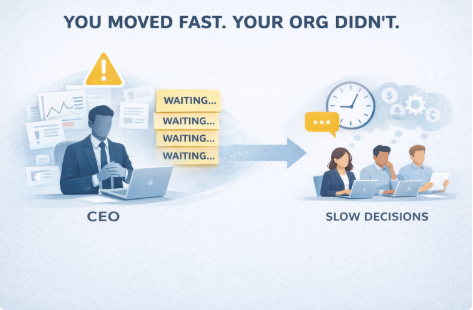
- Your org is not slow because your people are slow. It is slow because your structure never gave them permission to move.
- The Decision Architecture Framework maps who owns what and removes you from decisions you should never have been making.
- Speed at scale is a structural output. You either design for it or you work around it forever.
Why decisions slow down at scale is the question most CEOs ask too late. By the time you feel the drag deals stalling, managers waiting on your input, execution that used to take hours now take weeks the structure causing it has been baked in for months. Leadership and team management breaks when accountability exists without authority and ownership. The managers you hired to create speed became another layer you have to clear. The decisions you thought you delegated still land on your desk. The org you built to scale is the reason you are not scaling.
You did not build a slow company on purpose. You built a fast one. You made calls in real time, moved resources overnight, and out-executed every competitor who was still waiting for a meeting. That speed was your edge. And then you hired people, added layers, created process, and watched the same org that used to move in hours start moving in weeks. The speed did not disappear. It stopped flowing through the org and started pooling at the top with you.
Understanding why decisions slow down at scale starts with one uncomfortable data point. Research from West Monroe’s January 2026 “Speed Wins” study found that nearly three in four leaders estimate their organizations lose up to 5% of annual revenue from slow decision-making and delayed execution. The study found that the primary driver is not technology gaps or skills shortages it is leadership behavior: excessive approval layers, unclear decision rights, and risk-averse management that holds decisions at the top. You are not the exception. You are the pattern.
When Hiring & People Decisions Break Companies
Decision debt is not a metaphor. It is a measurable drag on every revenue-generating activity in your company. When your team cannot move without your sign-off, every deal slows down, every hire takes longer, every operational fix waits in a queue behind every other thing waiting on you. The cost shows up in missed windows, demoralized leaders, and an org that has quietly learned that initiative gets punished and escalation gets rewarded.
The deeper cost is talent. The leaders you recruited the ones who joined because they wanted ownership and a seat at the table start to disengage when they realize the seat comes with no authority. They stay on the org chart and stop contributing at the level you hired them to perform. You interpret this as a performance problem. It is a structure problem. You never gave them the decision rights that come with the accountability you assigned.
How You Built a Slow Org Without Knowing It
The pattern behind why decisions slow down at scale is consistent across scaling companies. In the early stage, founder speed is the product. You move fast because all the context lives in your head and every decision benefits from your proximity to the work. Then the company grows. You add managers. You run the same operating model on a larger org and wonder why it stops working. It stops working because the model was built for a company where one person held all the context. Now ten people need to act on context you are no longer close enough to hold.
The org slows down for three structural reasons. Ownership is unclear, so every decision gets escalated to whoever is willing to own it usually you. Authority and accountability are misaligned, so your managers have responsibility for outcomes they cannot drive without your approval. And the CEO remains the default decision-maker for every category that was never formally handed off. You are not a bottleneck because you want control. You are a bottleneck because you never made explicit decisions about where your control ends.
The Decision Architecture Framework
The Decision Architecture Framework starts by answering why decisions slow down at scale in your specific company. The diagnostic question is this: which decisions in this company require the CEO, and which ones do not? Most scaling CEOs have never answered this with any rigor. They have a sense of what they want to be involved in, but no explicit structure that communicates that to the org. The result is an org that escalates everything because the cost of making the wrong call without CEO input is higher than the cost of waiting.
The framework organizes decisions across two dimensions: frequency and consequence. High-frequency, low-consequence decisions the ones that happen daily and carry bounded risk belong at the front line or with the functional leader. Low-frequency, high-consequence decisions capital allocation, market pivots, executive changes belong at the CEO level. The middle ground requires clear ownership with defined escalation criteria. Map every major decision category your org makes. Assign an owner. Define the criteria for escalation. Then stop being the default answer when no owner is named.
The second component is authority alignment. Every manager you hold accountable for an outcome must hold explicit authority over the inputs that drive it. If your VP of Sales owns quota but needs your sign-off on discounting, deal structure, and headcount, you own quota. The title is cosmetic. Authority alignment means examining every accountability in your org and asking whether the person responsible for it has the actual power to deliver on it. Where the answer is no, you have a structure problem, not a performance problem.
The third component is decision graduation. Build a deliberate process for moving decision categories out of your hands and into the org over time. Start with the decisions that are highest frequency and the lowest consequence. Make the transfer explicit, state it in writing, communicate it to the team, and hold the new owner to it rather than rescuing them when the first call goes sideways. Decision graduation is how you build an org that runs on systems instead of on you.
What a Fast Org Actually Looks Like
The answer to why decisions slow down at scale becomes visible when you look at what a fast org does differently. Decisions get made at the level closest to the work. Escalations are rare and carry specific criteria; teams know exactly what warrants going up the chain. Leaders have the information and authority to act without checking in. Post-mortems on decisions focus on outcomes, not on whether the right person was consulted. And you, as CEO, are spending most of your time on the handful of decisions that only you can make.
The signal that tells you the architecture is working is not that your team never makes mistakes. It is that you stop finding out about decisions after the fact because someone forgot to loop you in. When the org has clear ownership and authority, people stop looping you in on things that do not require you. That shift from default approval authority to deliberate oversight is what a structurally fast org feels like from the inside.
The CEO Moves That Change This
Why decisions slow down at scale always traces back to four structural gaps that the CEO never closed.
- First, publish a decision rights document. Name every major decision category in the company and assign a single owner. Remove ambiguity.
- Second, audit every accountability in your leadership team against the authority that person actually holds. Close every gap where accountability exceeds authority.
- Third, identify the five decisions you make most frequently that you should not be making, and formally transfer them to the next level with an explicit communication to the org.
- Fourth, stop rescuing. When a leader you have given decision rights to makes a call you would not have made, let it land unless it crosses a defined escalation threshold. Every rescue teaches the org that the decision rights are not real.
These are not cultural interventions. They are structural ones. Culture follows structure. When you change who owns decisions and back it up with consistent behavior, the org recalibrates. Speed returns not because people work harder, but because the friction compressing every decision is gone.
Headquartered in Bellevue, WA, with an office in Boulder, CO, Oper Hand installs the revenue and operations systems that generate revenue, not burn it. The Efficiency Enhancer engagement addresses exactly this: clearing decision latency, closing authority gaps, and redesigning operational flow so your org executes without you in the middle. If you are ready to optimize your sales process and drive real growth, let’s talk.
Why decisions slow down at scale has one answer: you never built a structure that could make them without you. Your team is not the constraint. Your architecture is. And architecture is the one thing in this company you have full authority to change today.