
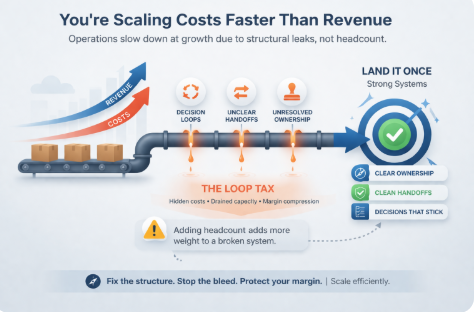
TL;DR
- Revenue climbing while margins compress is not a revenue problem. It is a structural problem.
- Adding headcount to solve what better systems should fix is the most expensive mistake a growing business makes.
- The Loop Tax, the hidden cost of decisions that return, drains capacity silently and compounds with every new hire.
- This post walks you through the diagnostic and the three moves that stop the bleed.
Revenue is up. Margins are not. That gap has a name: structural debt.
Most founders assume margin compression is a revenue problem. Price more. Close faster. Hire a better sales team. That framing is wrong, and it keeps the real problem running.
The bleed is operational. Decisions are not landing once. Work is looping. Headcount is rising to absorb complexity that better systems would eliminate. You are not scaling. You are staffing around a structural leak.
What Operational Drag Actually Looks Like
It does not announce itself. It shows up as friction: meetings that cover the same ground twice, handoffs that need follow-up to complete, decisions that get made and then revisited. None of it looks catastrophic in isolation. Together, it is quietly compressing your margins.
The most common signal at the growth stage: your cost per unit is rising even as volume increases. You expected scale to bring efficiency. Instead, it brought complexity. The systems that ran your business at 15 people were built for 15 people. They relied on proximity, memory, and your personal visibility to function. As the company grew, those informal mechanisms stopped working. Nobody replaced them with anything formal. That gap is where the drag lives.
The pressure is widespread. Chief Executive Magazine points to a consistent pattern in 2025: even when sales rise, costs are rising faster. For growth-stage companies where volume is increasing but systems have not caught up, this is not just an economic headwind. It is a structural failure that compounds with every new customer, every new hire, and every new quarter you let it run.
Why Growth Stages Create It Faster
At the startup stage, you absorb the failures. You catch the dropped handoff, make the call, fix the loop. It is unsustainable but it works. At the growth stage, you have a team. Failures do not get absorbed. They get distributed.
Each person handles their piece, passes it to the next, and when the handoff is unclear, the work returns. You are still catching it, but now there are ten times as many loops. The transition from founder-driven execution to systems-driven execution is the most operationally dangerous period in a company lifecycle.
Every role added without a clear ownership boundary increases the surface area for work to loop.
The Decision Loop Problem
A decision loop is what happens when a decision gets made but does not stay made. Someone acts on it, something ambiguous comes up, and the work returns for clarification. In a company of five, this takes minutes. In a company of 25, it takes days. In a company of 50, the loop has laps on it before anyone notices it started.
The cost is not just time. It is the confidence that erodes. When your team regularly sends work back up for clarification, they stop taking ownership of outcomes. They start executing tasks and waiting for direction. The execution bench you thought you were building is actually a queue of people waiting on you.
One unresolved ownership boundary generates two or three loops per week. Across ten roles, that is 20 to 30 decisions cycling back through leadership every week. Each one trains your team to escalate rather than decide.
The Fix: Land It Once
This is not a tool problem. It is not an org chart problem. It is a decision ownership problem. The repair sequence has three steps.
- Locate where decisions are not landing.
- Audit the work that returns. Where does your team seek clarification? Which handoffs generate the most follow-up? The pattern in the returns tells you exactly where ownership is broken.
- Assign authority at the point of decision.
- For each gap, the question is not who is responsible. It is who has the authority to close it. Responsibility without authority produces managers who manage tasks. Authority tied to a specific decision type produces leaders who own outcomes.
- Build the handoff so the work does not return.
- A handoff is a transfer of context and authority, not tasks. The receiving person needs enough information, enough authority, and a clear definition of done to close the loop without you.
What CEOs Get Wrong When They Try to Fix It
The instinct is to hire. Add an ops manager. Bring in a coordinator. The logic seems sound. The problem is that headcount added before ownership is clear does not reduce drag. It increases the surface area for loops. You have not solved the problem. You have added participants to it.
The second mistake is process documentation nobody uses. You document the workflow, share it in a meeting, move on. Three weeks later the same loop is running. Documentation without authority is wallpaper. It describes what should happen without giving anyone the power to enforce it.
The third mistake is treating operational drag as a morale problem. You reset expectations. The team nods. The loops keep running. Accountability without structure is pressure without direction. The fix is structural. The conversation is secondary.
Start This Week
Run a one-week loop audit. Every time a decision returns to you or a senior leader, log it: category, origin, what made it ambiguous, how long it took to resolve. At the end of the week, you will have a map of where your ownership boundaries are broken. That map is your repair list.
Work through it using the three-step sequence. Do not try to fix everything at once. Start with the three loops that return most frequently. Closing three high-frequency loops will have more impact on margin and team confidence than a full operational overhaul that takes four months.
Then measure cost per output, not just output volume. When you track cost per unit alongside volume, the efficiency gap becomes visible. You can see where adding headcount added cost without adding capacity. You can make structural decisions with numbers instead of instincts.
This is the work Oper Hand is built to do.
We map your decision loops and handoff failures. Then we install the ownership structure that lets decisions land once and stay landed. The results show up in weeks: in margin, in team behavior, and in the hours recovered from work that used to require you to close.
If your revenue is moving but the business feels heavier every quarter, the structure underneath it needs to change. That is a fixable problem.
Ready to fix it? Let’s talk.