
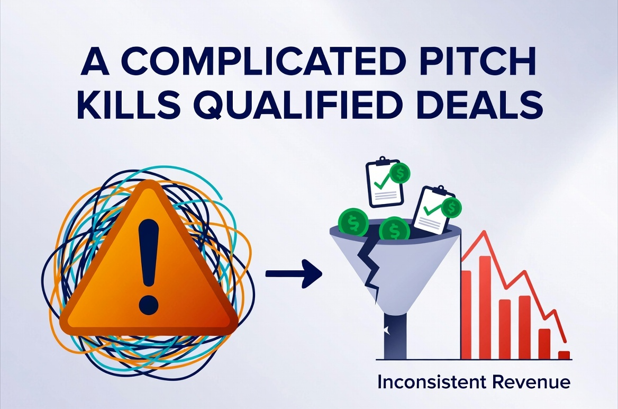
TL;DR
- CEO fix your sales pitch now, this is a P&L decision, not a marketing task.
- If your board asked you today why close rates are flat, your pitch is the honest answer.
- A pitch your reps cannot deliver consistently is a revenue leak you own.
- Diagnosing the problem is not enough. You have to make the call and install the fix.
- One sentence, decided by the CEO and run across the entire go-to-market motion, changes the number.
Leads and pipeline break when there is no full-funnel rigor or truth in the numbers. In growing businesses, that breakdown traces back to one decision the CEO has not made yet: what the pitch is, exactly, in one sentence, and that every rep delivers it the same way every time. You cannot delegate that decision. You cannot hire your way around it. Until you make it, your pipeline will keep showing activity without momentum, and your board will keep asking why the close rate is not moving.
When you were running founder-led sales, this did not matter. You knew the pitch intuitively. You felt the room. You adjusted in real time. The message was inside your head, and it came out sharp because you had internalized it over hundreds of conversations. But your company has grown past that. You have reps now. And those reps are delivering the version of your pitch they assembled from onboarding decks, product demos, a handful of your recorded calls, and whatever they intuited from your last sales meeting. They are working from fragments, and every fragmented conversation is a revenue event that did not close.
The signals show up in the P&L before they show up in a pipeline review. Your cost of acquisition is rising. Your close rate is flat or declining. Revenue is growing but margin is not, because you are adding headcount to compensate for a conversion problem that headcount cannot fix. When your board asks what is driving the trend, the real answer is that nobody in your go-to-market motion is saying the same thing. CEO fix your sales pitch now is not a slogan. It is the action item that sits above every other revenue initiative on your list.
What a Broken Pitch Costs You at the Board Level
The confusion does not announce itself. It hides inside optimism. Your reps mark opportunities as active because the prospect took the call and stayed on for forty-five minutes. What they do not record is that the prospect asked three versions of the same question, “So what exactly do you do?”, because the answer kept shifting. Complexity masquerades as thoroughness. The rep covered a lot of ground. The prospect heard a lot of words. And somewhere in the middle of that conversation, the decision to move forward quietly died.
At the board level, this shows up as forecast variance. Deals that were projected to close slip to next quarter. Win rates on qualified pipeline underperform against plan. Your investors ask whether the problem is the market, the product, or the team. The answer is none of those. The answer is that your pitch is doing different work in different hands, and the cumulative cost of that inconsistency lands directly on your revenue line. When the board asks that question in the next meeting, CEO fix your sales pitch now is the only honest answer you can give them, and the only one that comes with a clear action behind it.
Why Complexity Creeps In as You Grow
In the startup stage, your value prop was a direct answer to a specific and urgent problem. It was sharp because it had to be. You were selling against runway. Every word in your pitch had to earn its place or you did not close the deal. Then you found traction. You added features. You won customers in adjacent markets. You promoted a strong rep to a leadership role and hired two more behind them. And over the next twelve months, without anyone deciding to change the pitch, the pitch changed. Features got added to the explanation. Use cases multiplied. Qualifications expanded. The pitch grew in proportion to the business, and nobody flagged it because revenue was still growing. Pitch complexity is invisible in the early stages of growth. You see it in the data before you see it in the field, and by the time the board sees it, you are already a quarter behind.
Chandar Pattabhiram, Chief Go-to-Market Officer at Workato, framed the CEO fix your sales pitch now imperative precisely at Norwest’s 2024 growth marketing summit: apply your deepest customer knowledge to identify the “onlyness” of your product. Only your company gives your audience your differentiating capability. If you cannot complete that statement succinctly, you have a clarity problem that is actively costing you pipeline.
The One-Sentence Test
The One-Sentence Test is the diagnostic every CEO needs to run before the next board meeting. The test is this: have each of your reps, independently and without preparation, write down in one sentence what your company does and who it is for. Not a tagline. Not a positioning statement lifted from your website. One plain sentence that a qualified buyer would hear and immediately recognize as relevant to a problem they are actively trying to solve.
When you compare the results across your team, you will find two to four genuinely different answers. Some will lead with the product. Some will lead with the outcome. Some will reference an industry vertical you have not actively sold into in six months. None of them will be wrong, exactly. They will simply be inconsistent. That inconsistency is not a training problem. It is a leadership problem. You have not decided what the sentence is, so your team invented their own versions. The One-Sentence Test tells you exactly where CEO fix your sales pitch now belongs on your priority list, above hiring, above tooling, and above any sales enablement initiative currently on your roadmap.
What the CEO Has to Do Next
This is not a messaging exercise and it is not a marketing initiative. It is a revenue decision that the CEO makes, writes down, and installs across the entire go-to-market motion this week. Start with your last twelve closed-won deals. Pull the call recordings or the rep notes from the initial discovery conversation. Identify the problem statement, not your framing of the problem, but the language the buyer used to describe the constraint they were trying to remove. You will find a pattern. That pattern is your pitch. It already exists inside your pipeline. You have not operationalized it yet.
Once you have identified the common language across your best closed deals, build one sentence from it. The sentence names who you work with, the specific problem you remove, and the outcome the buyer gets. Keep it under twenty words. Test it by reading it aloud and asking whether a qualified prospect who has that problem would lean forward or stay neutral. If they lean forward, you have a usable sentence. If they stay neutral, you are still describing your company instead of their problem.
Then do three things before the end of the week. Make that sentence the required opening of every outbound message. Put it on the first slide of every deck. Build it into rep onboarding as a non-negotiable deliverable before anyone speaks to a prospect. CEO fix your sales pitch now means exactly that, not next quarter, not after the next hire, and not after the next sales training. This week. The CEO who sets that standard and holds the team to it stops watching close rates drift and starts managing a predictable revenue system.
What Changes When the CEO Makes the Call
Pipeline quality improves before volume does. When your reps lead with a precise problem statement, the prospects who do not have that problem self-select out earlier. That feels like a loss when it happens. It is not. It is pipeline efficiency. The deals that advance are deals where the problem is real, the urgency is present, and the buyer already understands at a functional level why they are talking to you. Your close rate goes up because your qualification rate goes up. Your forecast accuracy improves because deals in your pipeline are actually deals. CEO fix your sales pitch now and your board stops asking why the numbers are soft, because the numbers are no longer soft.
Consistent messaging also compounds across your team in ways that are easy to underestimate. When every rep uses the same sentence, you start to accumulate data about which problems surface most often in discovery, which objections repeat, and which deals move fastest. You can train against real patterns instead of rep intuition. You can walk into a board meeting with a pipeline that is defensible at every stage because the entry criteria are clear, the pitch is consistent, and the close rate reflects a system rather than individual heroics. That is the business your board wants to fund and your investors want to scale.
At Oper Hand, the Growth Catalyst engagement installs the revenue system that makes this discipline permanent across your team. Headquartered in Bellevue, WA, with an office in Boulder, CO, we install the revenue and operations systems that generate revenue, not burn it. If you are ready to optimize your sales process and drive real growth, let’s talk.
Your board is not asking about your pitch because they enjoy the conversation. They are asking because the number on the P&L is telling them something you have not fixed yet. CEO fix your sales pitch now is the decision that changes what that number says next quarter. You already have the data. You already know which deals closed and why. The only thing between your current close rate and a better one is the decision to make one sentence the standard and hold every rep to it.