
Systems Thinking

Systems thinking is a holistic approach to organizational management that focuses on how a company’s various functions—sales, operations, and leadership—interact and influence one another. For scaleups (10–200 employees), it involves identifying the root causes of friction and designing feedback loops that ensure a change in one department drives positive outcomes across the entire business ecosystem.

A Formula 1 car crashing into a concrete barrier at full speed, debris scattered across the track, illustrating what happens when strategic validation is skipped — unchecked speed without direction control ends in a costly, avoidable impact

Why Fast-Moving Companies Make the Slowest Strategic Decisions

TL;DR Speed at the tactical level creates the illusion of strategic momentum. It is not the same thing. The gap between thinking and doing is where strategic validation lives. Fast-moving companies eliminate that gap and call it efficiency. Most pivots are not strategic moves. They are validation failures that ran too long before anyone named […]

Why Fast-Moving Companies Make the Slowest Strategic Decisions Read More »

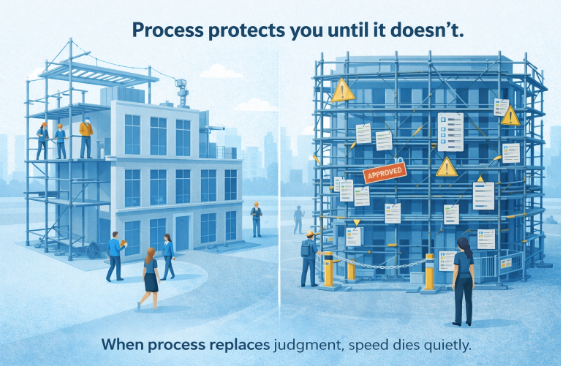
Illustration showing two construction sites side by side—one moving smoothly with minimal oversight and another overloaded with approvals, warning signs, and paperwork—highlighting how excessive controls slow execution and why process discipline for growing companies must support judgment instead of replacing it.

Process Protects You Until It Doesn’t

Editor’s Note: Authored by the Oper Hand Insights Desk under the direction of Steve Ross. Every insight is verified against Steve’s 30-year ‘Oper Hand Lens’, acquired in the trenches of B2B startups and scaleups. Content is cross-referenced with sources such as The Wall Street Journal, Forbes, Harvard Business Review, Entrepreneur, and others. This piece is about process discipline for

Process Protects You Until It Doesn’t Read More »

Founder deciding on startup accountability systems that work. Oper Hand Boulder CO and Seattle WA locations.

Startup Accountability Systems That Actually Work

Most startup teams aren’t lazy. They’re lost. What they need are startup accountability systems that work. Your team is not sitting around waiting to be told what to do because they don’t care. They’re waiting because the signals are unclear: Priorities shift weekly. Ownership is fuzzy. Accountability is either missing or weaponized. And the founder,

Startup Accountability Systems That Actually Work Read More »

Illustration of a startup office building with a large crack in the foundation. Founders and employees work on laptops, unaware of the damage. The image represents the need for a Startup Operational Health Playbook. Oper Hand helps founders in Seattle, WA, Boulder, CO, and across the US and Canada build systems that scale.

The Startup Operational Health Playbook

Your startup’s operational health isn’t a nice-to-have; it’s a must-have. It’s the difference between a business that’s scalable and one that collapses under its weight. You need to run a startup operational playbook. Most founders don’t think they have time to step back and audit their operations. They’re too busy chasing the next deal, managing

The Startup Operational Health Playbook Read More »

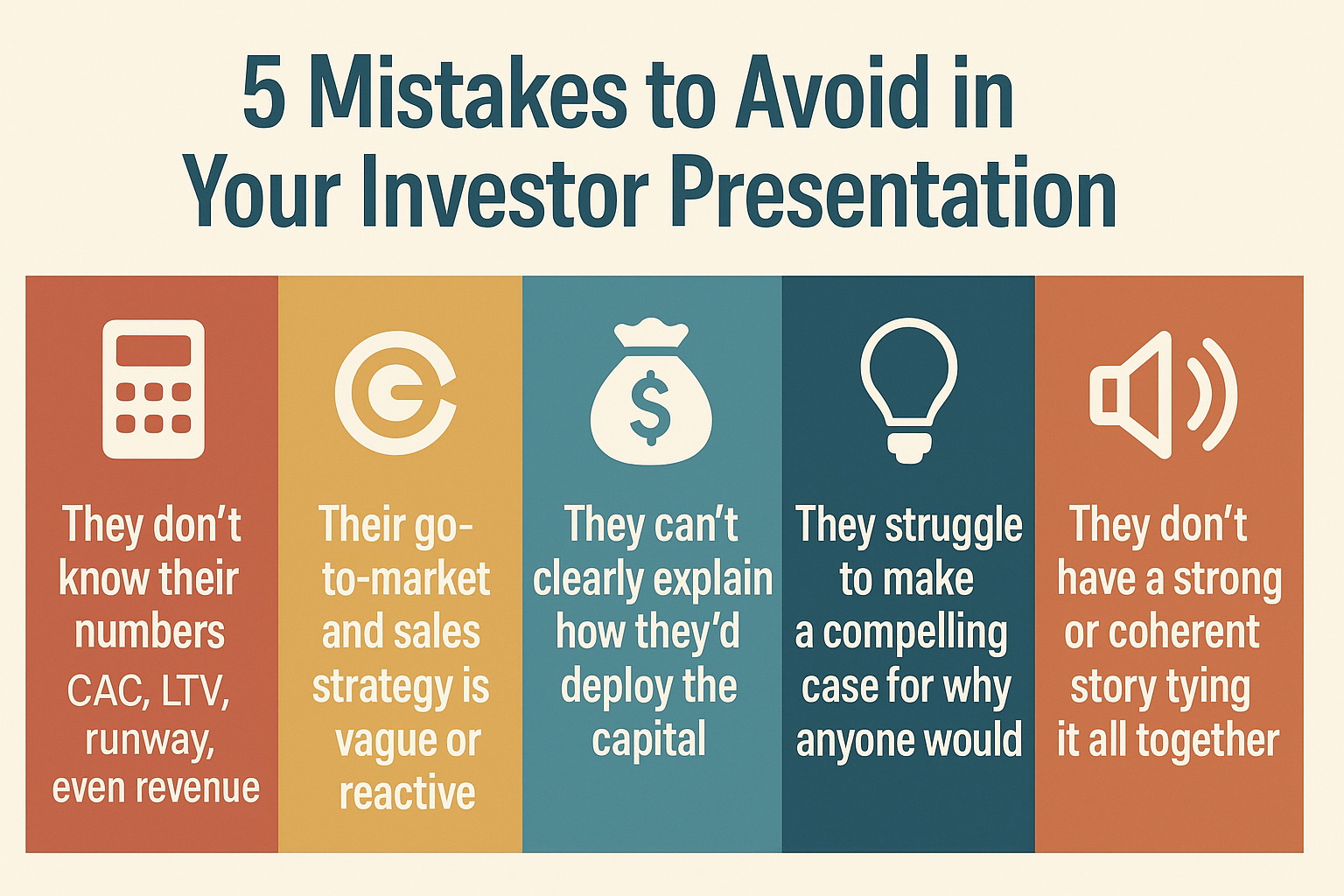
Infographic highlighting 5 key investor pitch mistakes to avoid, including lack of financial clarity, weak go-to-market strategy, unclear capital deployment, poor customer justification, and disjointed storytelling—designed to help founders deliver stronger, investor-ready presentations.

Investor Pitch Mistakes to Avoid: 5 Insights from a Revenue-Focused Fractional COO

As an active investor, I’m often in the room during pitch meetings to investors. There are five investor pitch mistakes to avoid. The difference usually comes down to clarity, control, and whether the founder knows how to communicate what matters most to investors. When raising capital, most founders obsess over pitch design, timing, and warm

Investor Pitch Mistakes to Avoid: 5 Insights from a Revenue-Focused Fractional COO Read More »

Digital dashboard displaying key business metrics like customer engagement and sales pipeline growth, symbolizing the use of leading indicators for business growth

Leading Indicators: The CEO’s Secret to Predictable Growth

As a business leader, you probably track metrics that show what’s already happened. These lagging indicators—like quarterly revenue, customer churn, or total sales—tell you where you’ve been but don’t help you steer where you’re going. To achieve leading indicators for business growth, you need to shift focus to forward-looking metrics that signal future outcomes and

Leading Indicators: The CEO’s Secret to Predictable Growth Read More »

Scroll to Top
Call Us