Executive Alignment

Executive alignment is the strategic synchronization of a leadership team’s priorities, decision-making frameworks, and communication loops. For scaleups, it ensures that the CEO, Founders, and Department Heads are operating from a single source of truth to prevent departmental silos and ‘strategy drift.

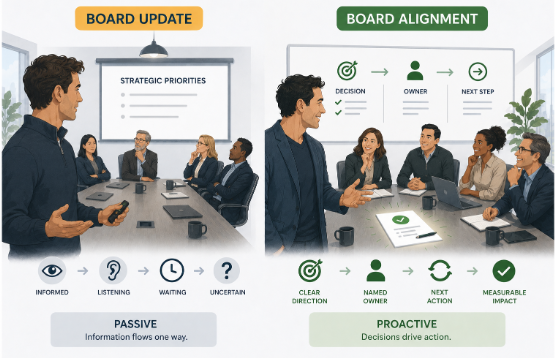
Illustration comparing a passive board update meeting with a proactive board alignment session, highlighting common CEO board mistakes such as one-way communication, unclear ownership, delayed decisions, and lack of measurable action. The left side shows executives sitting through a status-driven update with uncertainty and waiting, while the right side shows a collaborative leadership discussion focused on clear direction, accountability, next steps, and measurable impact.

You’re Reporting to Your Board. Not Leading Them.

TL;DR The boardroom is where CEO board mistakes get made. Most CEOs walk out having presented well. The company pays for it three weeks later. Business strategy breaks when teams accelerate execution before the board has committed to anything. The meeting felt productive. The questions were sharp. Then nothing moved. The gap between what the […]

You’re Reporting to Your Board. Not Leading Them. Read More »
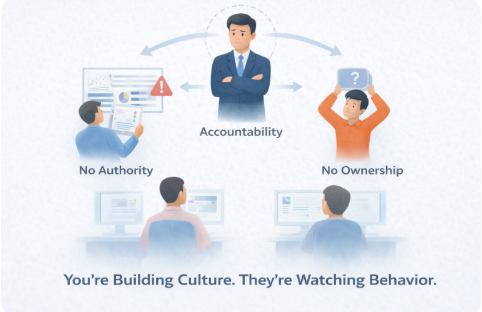
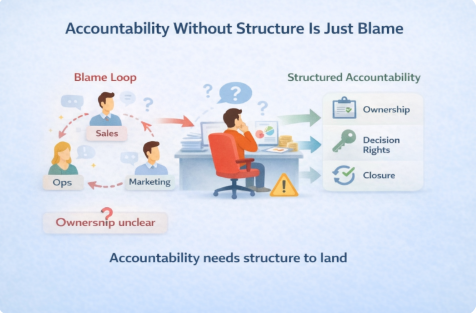
Illustration showing how leaders shape company culture through accountability, authority, and ownership. A business leader stands at the center while team members around them display signs of confusion, lack of authority, and lack of ownership, highlighting how employee behavior reflects leadership structure and decision-making.

You’re Building Culture. They’re Watching Behavior.

TL;DR Your team is not underperforming. They are performing exactly to the standard your behavior sets. Culture is not built in offsites or value statements. It is built in every decision you make in public. Leadership and team management breaks when accountability exists without authority and ownership, and the CEO stays in the middle. The

You’re Building Culture. They’re Watching Behavior. Read More »

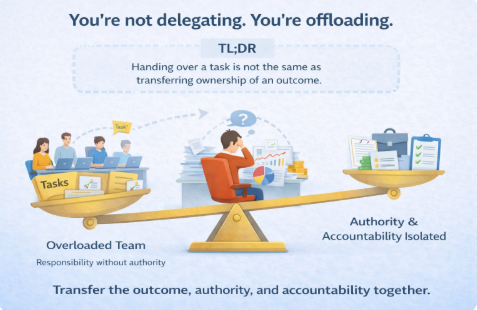
Illustration showing an unbalanced scale representing why delegation fails growing companies. On one side, an overloaded team handles multiple tasks without authority, while on the other side, authority and accountability are isolated with a stressed leader sitting between the imbalance. The graphic emphasizes that handing over tasks is not the same as transferring ownership of outcomes, highlighting the need to transfer outcome responsibility, authority, and accountability together.

You’re not delegating. You’re offloading.

TL;DR Handing someone a task is not the same as giving them ownership of an outcome. Most Growing Business founders stay the bottleneck even after they delegate because they transfer work without transferring authority or accountability. Understanding why delegation fails growing companies starts with recognizing that task handoffs and ownership transfers are not the same

You’re not delegating. You’re offloading. Read More »

A Formula 1 car crashing into a concrete barrier at full speed, debris scattered across the track, illustrating what happens when strategic validation is skipped — unchecked speed without direction control ends in a costly, avoidable impact

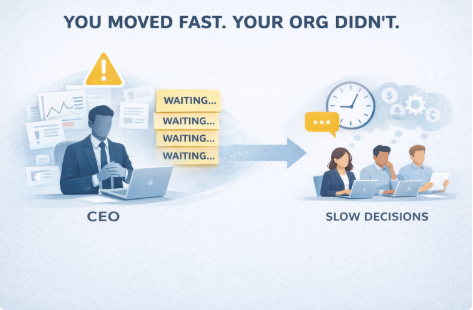
Why Fast-Moving Companies Make the Slowest Strategic Decisions

TL;DR Speed at the tactical level creates the illusion of strategic momentum. It is not the same thing. The gap between thinking and doing is where strategic validation lives. Fast-moving companies eliminate that gap and call it efficiency. Most pivots are not strategic moves. They are validation failures that ran too long before anyone named

Why Fast-Moving Companies Make the Slowest Strategic Decisions Read More »

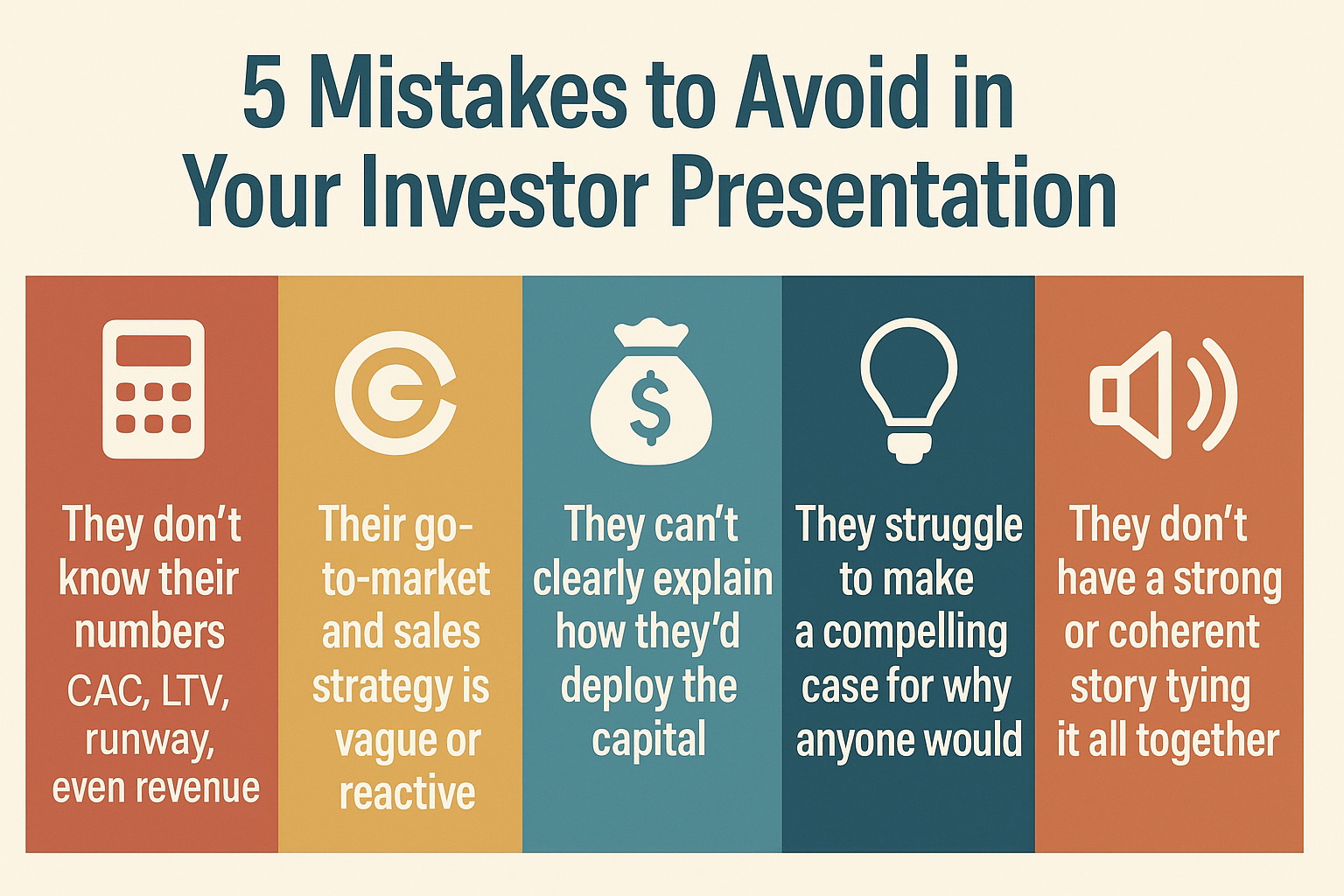
Infographic highlighting 5 key investor pitch mistakes to avoid, including lack of financial clarity, weak go-to-market strategy, unclear capital deployment, poor customer justification, and disjointed storytelling—designed to help founders deliver stronger, investor-ready presentations.

Investor Pitch Mistakes to Avoid: 5 Insights from a Revenue-Focused Fractional COO

As an active investor, I’m often in the room during pitch meetings to investors. There are five investor pitch mistakes to avoid. The difference usually comes down to clarity, control, and whether the founder knows how to communicate what matters most to investors. When raising capital, most founders obsess over pitch design, timing, and warm

Investor Pitch Mistakes to Avoid: 5 Insights from a Revenue-Focused Fractional COO Read More »

A Fractional COO for Revenue Growth leading a strategy meeting with a startup team, optimizing operations and driving business success

Fractional COO for Revenue Growth: Ten Reasons to Hire

TL;DR: A Fractional COO for Revenue Growth helps startups and SMBs scale efficiently by optimizing operations, improving sales processes, and driving strategic execution—without the cost of a full-time executive. Key Benefits of a Fractional COO for Revenue Growth: High-level expertise, lower cost – Get C-suite leadership at a fraction of the price. Scalable engagement –

Fractional COO for Revenue Growth: Ten Reasons to Hire Read More »

Scroll to Top
Call Us